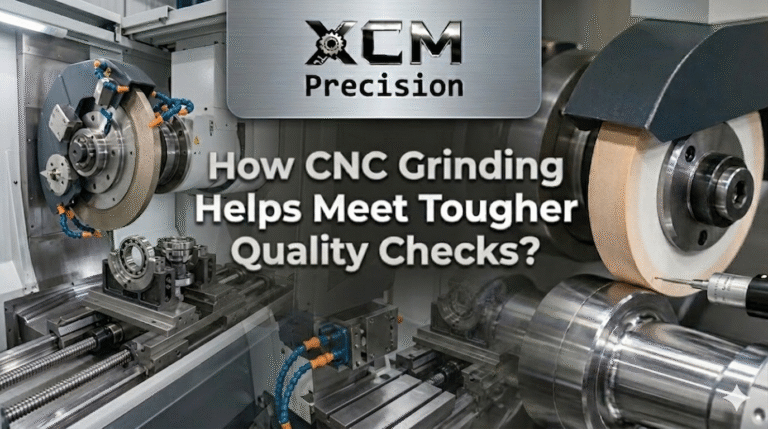
Quality checks are getting tougher because modern components are expected to fit better, last longer, and perform with fewer production errors. A small surface mark, uneven diameter, loose tolerance, or rough contact area can affect the entire assembly.
CNC grinding helps solve this issue by giving parts a controlled final finish after machining or fabrication. It brings surfaces, round parts, profiles, and tight-tolerance components closer to the required engineering standards without changing the basic shape of the part.
For manufacturers, this final step can make inspection smoother and more dependable.
XCM CNC Grinding for Precision Finishing
XCM uses CNC grinding as a finishing process for parts that need exact dimensions, smoother surfaces, and steady repeatability. The process supports flat surfaces, round components, custom profiles, machined parts, and fabricated components that need final correction before approval.
This step is not about removing heavy material. It is about reaching the right size, surface finish, and tolerance range. That is why it is often used near the end of production, when the part already has its main shape but still needs a sharper level of accuracy.
A controlled grinding process helps reduce common inspection issues, such as uneven thickness, rough surface marks, poor diameter control, and small shape variations between parts.
Where Grinding Fits in the Production Process
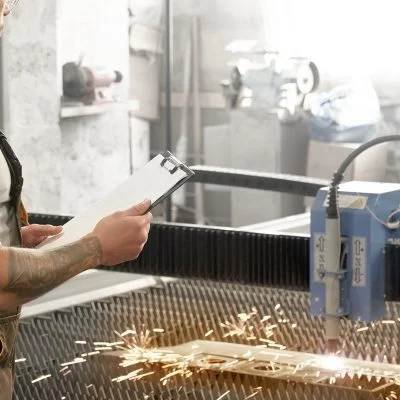
Machining creates the shape. Grinding improves the details. This difference matters when a part must pass tighter quality checks.
Standard machining may be enough for many general components, but high-performance parts often need more careful finishing. Grinding can refine contact areas, smooth functional surfaces, and bring dimensions closer to the required range.
This is useful for parts such as shafts, plates, pins, rollers, tooling components, structural parts, and precision assemblies. When these parts need better fit and smoother operation, grinding becomes a practical step rather than an optional extra.
Surface Grinding for Flat and Parallel Parts
Surface grinding is used when components need flatness, smoothness, and controlled thickness. It is suitable for plates, blocks, tooling parts, and other components that must sit evenly against another surface.
Poor flatness can create gaps during assembly. Uneven thickness can cause alignment issues. Surface grinding helps reduce these problems by improving surface contact and keeping the part closer to the required measurement.
This process can support:
- Uniform flatness across the part
- Better thickness control
- Fewer surface marks
- Cleaner assembly fit
- More consistent surface finish
For quality checks, this is important because flatness and parallelism are not always visible. A part can appear acceptable but still fail when measured with proper inspection tools.
Cylindrical Grinding for Round Components
Round parts need careful control because many of them rotate, slide, seal, or carry load. Shafts, pins, rollers, and similar components often need accurate diameter, roundness, and smooth surface texture.
CNC grinding helps create smoother functional surfaces and better diameter control. This can improve how a part performs inside rotating assemblies or close-fit systems.
Even a small diameter error can change how a component moves. It may create vibration, wear, poor contact, or assembly pressure. A smooth and accurate round surface helps reduce these risks and supports more stable performance.
Quality checks for round components often focus on diameter accuracy, concentricity, roundness, and surface smoothness. When these areas are controlled, the part has a better chance of passing inspection and working properly in use.
Profile Grinding for Complex Shapes
Some parts are not simple flat plates or round bars. They may include steps, shoulders, angles, grooves, contours, or internal features. These shapes can be harder to finish because each area may have its own tolerance and function.
Profile grinding helps finish these details with programmed control. It supports accuracy across custom shapes and helps keep the same profile consistent from one part to the next.
This is useful for components that require contour grinding, step grinding, shoulder finishing, profile grinding, and fine tolerance finishing for complex forms.
Complex geometry leaves less room for guesswork. If one profile must repeat across several parts, CNC-controlled grinding helps protect both shape accuracy and production consistency.
How CNC Grinding Supports Quality Checks?
| Quality Check Area | What Inspectors Look For | How Grinding Helps |
| Dimension control | Correct size, thickness, and diameter | Removes small amounts of material with fine control |
| Surface finish | Smoothness, texture, and visible surface marks | Creates cleaner and more refined surfaces |
| Flatness | Even surface across the component | Improves contact and assembly fit |
| Roundness | Correct circular shape in shafts or pins | Helps reduce vibration and uneven movement |
| Repeatability | Same result across many components | Supports stable production output |
| Fit and function | How parts work inside assemblies | Reduces friction, gaps, and wear points |
Why Surface Finish Affects Real Performance?
Surface finish is often connected with appearance, but its real value is functional. A smoother surface can reduce friction, improve contact, support sealing, and help coatings or finishing layers hold better.
Rough or uneven surfaces may wear faster. They may also cause poor sealing, extra movement resistance, or small alignment issues inside mechanical systems.
A refined finish can improve contact surfaces, reduce wear points, support better coating adhesion, and help parts move with less friction. These details matter because quality checks are not only about whether a part looks correct. They also help predict how the part may behave under use.
When XCM Grinding Support Becomes Important?
XCM CNC grinding support becomes important when standard machining is close but not accurate enough for the final requirement. Some parts need very tight dimensional control, smoother contact surfaces, and better repeatability across batches.
This is where CNC grinding can help manufacturers meet stricter inspection needs without changing the purpose of the part. It gives the component a more controlled finish and helps prepare it for real operating conditions.
Parts used in automotive manufacturing, aerospace engineering, industrial machinery, and tool production often need this extra level of control. When the tolerance is tight, the final surface matters as much as the main shape.
Conclusion
Tougher quality checks are not only about stricter inspection. They are about better parts, safer assemblies, and fewer failures after production. CNC grinding helps meet these demands by improving size control, surface finish, flatness, roundness, and repeatability. It gives components the final level of accuracy that many demanding applications need.
For manufacturers working with precision parts, contact XCM’s team. They provides grinding support that helps reduce inspection risks and improve confidence in the finished component. When every small detail matters, the final finishing process becomes one of the most important steps.