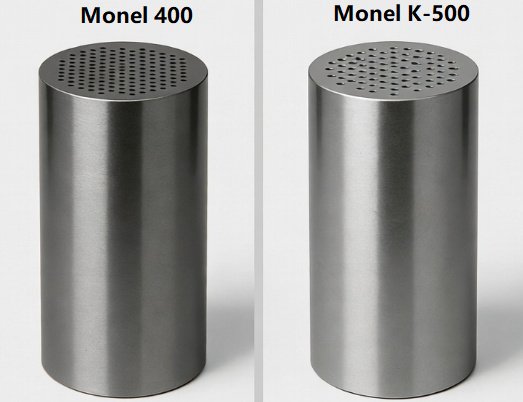
Monel 400 and Monel K-500 are two widely used nickel-copper alloys known for excellent corrosion resistance in marine and chemical environments. Although they share a similar base composition, they differ significantly in strength, hardness, and typical application fields. This article provides a systematic, engineering-focused comparison to support material selection, design, and procurement decisions.
Chemical Composition Comparison
Both alloys are nickel-copper systems with additional elements for property control. Monel 400 is essentially a solid-solution alloy, while Monel K-500 is an age-hardenable variant containing more aluminum and titanium for precipitation strengthening.
| Element | Monel 400 | Monel K-500 |
|---|---|---|
| Nickel (Ni) | ≈ 63.0 min (including Co) | ≈ 63.0 min (including Co) |
| Copper (Cu) | 28.0 – 34.0 | 27.0 – 33.0 |
| Iron (Fe) | 2.5 max | 2.0 max |
| Manganese (Mn) | 2.0 max | 1.5 max |
| Silicon (Si) | 0.50 max | 0.50 max |
| Carbon (C) | 0.30 max | 0.25 max |
| Sulfur (S) | 0.024 max | 0.010 max |
| Aluminum (Al) | — (residual) | 2.30 – 3.15 |
| Titanium (Ti) | — (residual) | 0.35 – 0.85 |
| Other | Co up to ~2.0 typically | Co up to ~2.0 typically |
The key compositional distinction is the deliberate addition of aluminum and titanium in Monel K-500, which enables age-hardening through the formation of finely dispersed Ni3(Al,Ti) precipitates. This microstructural difference is the main driver of the much higher mechanical strength of K-500 compared with Monel 400.
Microstructure and Strengthening Mechanisms
Monel 400 is a single-phase solid solution alloy in the annealed condition, with nickel-rich matrix containing copper and minor alloying elements. Strength is primarily controlled by solid-solution hardening and cold work. Heat treatment is mainly used for stress relief and grain size adjustments, but it cannot produce significant precipitation hardening.
Monel K-500 uses an age-hardening mechanism:
- Solution annealing at elevated temperature to dissolve strengthening phases.
- Quenching to retain a supersaturated solid solution.
- Ageing at intermediate temperatures to precipitate Ni3(Al,Ti), resulting in high yield and tensile strength.
This precipitation-hardened microstructure gives K-500 significantly higher strength and hardness at comparable or slightly higher density. However, the presence of precipitates also influences machining behavior, weldability, and stress corrosion sensitivity.
Mechanical Properties
Mechanical properties depend on product form, heat treatment, temper, and product specification. The ranges below are representative values for typical wrought products at room temperature.
| Property | Monel 400 (annealed) | Monel K-500 (age hardened) |
|---|---|---|
| Density (g/cm³) | ≈ 8.80 | ≈ 8.44 – 8.60 |
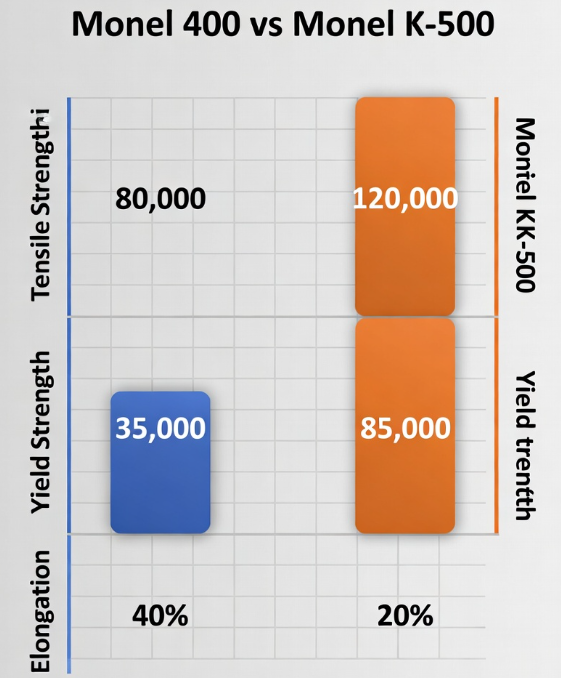
| Tensile Strength (MPa) | ~ 480 – 620 | ~ 965 – 1100 (some conditions higher) |
| 0.2% Yield Strength (MPa) | ~ 170 – 345 | ~ 690 – 860 |
| Elongation (%) | ~ 30 – 40 | ~ 15 – 25 |
| Hardness (HBW) | ~ 120 – 180 | ~ 250 – 320, depending on age condition |
| Modulus of Elasticity (GPa) | ~ 179 – 185 | ~ 179 – 185 |
Monel 400 offers moderate strength with high ductility, making it suitable where formability, toughness, and excellent corrosion resistance are priorities. Monel K-500 provides substantially higher strength and hardness, enabling component size reduction or load capacity increase, particularly valuable for fasteners, shafts, and springs.
Corrosion Resistance in Various Environments
Both alloys are notable for corrosion resistance, especially in chloride-bearing and marine environments. Their performance, however, is not identical in all media.
General Corrosion in Seawater and Brines
Monel 400:
- Excellent resistance to rapidly flowing seawater.
- Very low corrosion rates in quiet or stagnant seawater, though may show surface film formation and minor attack in severely polluted or low-oxygen conditions.
- Good resistance to salt solutions and brines, including many chloride and sulfate brines.
Monel K-500:
Shows general corrosion behavior broadly similar to Monel 400 in many marine environments. The precipitation hardening process does not drastically change bulk corrosion rate in seawater, but K-500 is slightly more prone to certain localized phenomena under high tensile stress (e.g., stress corrosion in specific conditions).
Acids, Alkalis and Neutral Solutions
Both alloys demonstrate:
Good resistance to many acids, particularly hydrofluoric and organic acids, as well as neutral and alkaline salts. They typically show good performance in caustic alkali solutions under many service conditions.
In strong oxidizing media, such as hot concentrated nitric acid, their performance is limited and alternative materials are often preferred.
Stress Corrosion Cracking and Hydrogen Embrittlement
Monel 400:
Generally shows good resistance to stress corrosion cracking (SCC) in most marine and neutral chloride environments compared with high-strength steels and some stainless steels. In very specific combinations of high tensile stress, elevated temperature, and aggressive chemicals, susceptibility may increase; however, SCC is not usually the primary design concern for Monel 400.
Monel K-500:
Because of its higher strength and presence of precipitates, Monel K-500 can exhibit more susceptibility to certain forms of SCC and hydrogen embrittlement, particularly in sour (H2S-containing) environments or highly stressed components such as fasteners and springs. Proper material selection, control of hardness, and adherence to relevant sour service standards are important when using K-500 in oil and gas applications.
Physical Properties and Thermal Behavior
Key physical properties influence design, thermal stress calculations, and compatibility with other materials.
Monel 400 and Monel K-500 have similar:
Thermal expansion coefficients in the typical range for nickel-based alloys, useful when joining with other nickel alloys or austenitic stainless steels. Thermal conductivity is relatively high compared with many stainless steels, beneficial for heat exchanger and condenser design.
Both alloys maintain toughness and useful mechanical properties at sub-zero temperatures, making them suitable for low-temperature services such as cryogenic equipment, though detailed design should follow applicable codes and data for the specific product form.
Workability, Forming and Machining
Forming and machining behavior is a key practical differentiator between Monel 400 and Monel K-500 in manufacturing.
Cold and Hot Forming
Monel 400:
Good ductility and malleability. It can be cold worked by rolling, bending, and drawing to achieve higher strength levels. Cold working substantially increases strength while retaining adequate toughness.
Hot working is typically carried out in moderate temperature ranges recommended by the alloy producer to avoid grain growth or surface oxidation. Proper intermediate annealing may be used for complex shapes.
Monel K-500:
In the solution-annealed condition, formability is acceptable, though somewhat less than Monel 400 because of its compositional modification. Most hot and cold forming processes are done prior to age hardening.
Once age hardened, Monel K-500 becomes significantly harder and less formable. Forming operations are usually not recommended or are very limited in the fully hardened condition. For complex geometries, forming in the soft state followed by ageing is preferred.
Machinability
Monel 400:
Machinability is comparable to other solid-solution nickel alloys. It tends to work-harden; sharp tools, rigid setups, and sufficiently heavy feeds are important to cut below work-hardened layers. Cutting speeds are usually lower than for carbon steels.
Monel K-500:
In the age-hardened condition, it is significantly more difficult to machine than Monel 400 due to higher strength and hardness. Tool wear and heat generation are more severe. Many manufacturers prefer to machine K-500 in the solution-annealed or partially aged condition, followed by final age hardening to achieve full strength.
Consideration for productivity and tool life is critical. When specifying K-500 parts, designers sometimes adjust tolerances and finishing operations to account for increased machining difficulty.
Weldability and Joining Considerations
Both Monel 400 and Monel K-500 are weldable, but the appropriate filler metals, procedures, and post-weld treatments differ.
Monel 400 Welding
Monel 400 is generally considered readily weldable by common processes such as GTAW (TIG), GMAW (MIG), SMAW (stick), and others, using matching or compatible nickel-based filler materials. Typical points:
Proper control of heat input and interpass temperature limits grain growth and preserves mechanical properties. Preheating is usually not required for thin to medium sections. Post-weld heat treatment is seldom necessary except for special stress-relief requirements.
Monel K-500 Welding
Monel K-500 is more sensitive to welding conditions:
Welding in the age-hardened condition can lead to a softened heat-affected zone (HAZ) and local loss of precipitation strengthening. Often, components are welded in the solution-annealed condition and subsequently age hardened to restore uniform properties.
Without proper procedure, there can be increased risk of cracking or reduced mechanical properties in the HAZ. Specialized welding consumables and carefully controlled parameters are commonly specified. In highly stressed or critical service, it is important to follow alloy producer recommendations and applicable welding qualification standards.
Heat Treatment Practices
Heat treatment differs markedly between the two alloys because only Monel K-500 is designed for precipitation hardening.
Monel 400 Heat Treatment
Monel 400 is non-age-hardenable. Typical heat treatments include:
Annealing at elevated temperatures followed by controlled cooling to restore ductility and relieve work hardening from cold forming. Stress relieving at lower temperatures to reduce residual stresses without major changes in mechanical properties.
Mechanical strength increases are primarily achieved through cold work; heat treatment alone does not provide significant strengthening.
Monel K-500 Heat Treatment
Monel K-500 heat treatment typically follows a solution anneal plus age-hardening sequence:
Solution annealing at a high temperature to dissolve precipitates and homogenize microstructure, followed by rapid cooling. Ageing at intermediate temperature for a defined time to allow precipitation of Ni3(Al,Ti), increasing strength and hardness.
By adjusting ageing temperature and duration, different combinations of strength and toughness can be achieved. Over-ageing can reduce strength, so process control is critical. For welded structures, post-weld solution treatment and ageing are sometimes used to achieve consistent properties, where design and fabrication codes permit.
Typical Applications of Monel 400
Monel 400 is selected where corrosion resistance and toughness are critical and very high strength is not the primary requirement.
Marine and Offshore Equipment
Heat exchangers, condensers, and cooling coils exposed to seawater. Piping systems and fittings in seawater service. Pump and valve components where resistance to seawater and brine is required. Propeller shafts and marine hardware in moderate-to-high velocity seawater.
Chemical and Petrochemical Processing
Equipment handling hydrofluoric acid and fluorine-containing media under defined conditions. Processing equipment for alkali and salt production. Brine heaters, evaporators, and crystallizers operating in chloride or sulfate solutions where stainless steels may suffer pitting or crevice corrosion.
Other Industrial Uses
Pickling operations and acid handling equipment where suitable. Feedwater heaters and boiler components subject to mixed salt contamination. Components in low-temperature or cryogenic service requiring toughness and corrosion resistance.
Typical Applications of Monel K-500
Monel K-500 is selected where both corrosion resistance and high mechanical strength are required, often under cyclic loading or high bolt preload.
High-Strength Marine Components
High-strength shafts, such as pump and propeller shafts requiring greater load capacity than Monel 400 can provide. High-strength fasteners, pins, and couplings used in offshore platforms and subsea equipment. Springs and spring components used in corrosive marine environments.
Oil, Gas and Sour Service
Downhole tools and components where a combination of strength and corrosion resistance in brines and some sour environments is required, subject to compliance with hardness and environmental cracking requirements. High-strength nonmagnetic components used in logging tools and drilling equipment.
Pump and Valve Components
Impellers, pump shafts, valve stems, and other rotating or stressed parts requiring both seawater resistance and high fatigue strength. Components in high-pressure systems where reduced cross-section is desirable for weight or space constraints.
Standards, Specifications and Product Forms
Monel 400 and Monel K-500 are covered by a range of international and industry standards. Exact designations and requirements vary by region and product form (bar, plate, forging, pipe, etc.). Commonly used standards include ASTM, ASME and equivalent specifications defining chemical composition, mechanical properties, testing methods, and permissible tolerances.
Typical product forms include:
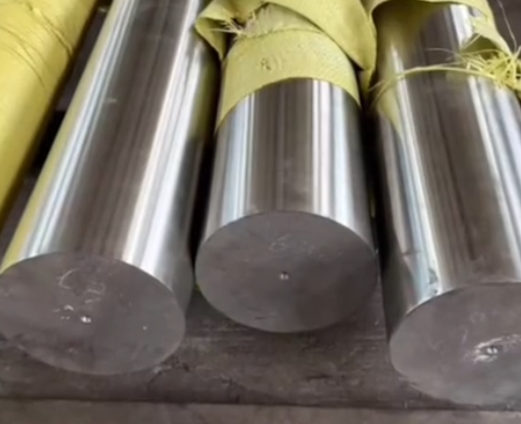
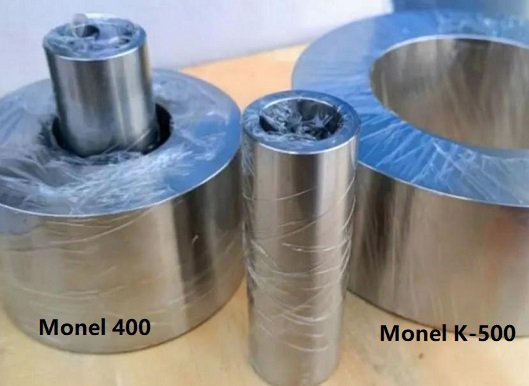
Bars and rods, suitable for machining into fasteners, shafts, and general components. Plate, sheet, and strip, used in vessel fabrication, heat exchangers, and structural components. Seamless and welded pipe and tube for fluid handling systems. Forgings for highly stressed mechanical components.
When selecting a product form, the required specification, heat treatment, and testing requirements should align with the intended service conditions and industry-specific regulations.
Selection Guidelines: Monel 400 vs Monel K-500
Choosing between Monel 400 and Monel K-500 requires balancing corrosion resistance, mechanical requirements, fabrication processes, and cost considerations at the component and system level.
When Monel 400 is Generally Preferred
Monel 400 is typically favored when:
Service environment is strongly corrosive (e.g., seawater, non-oxidizing acids, brines) but loads are moderate. High ductility and toughness are important for forming, bending, and welding. Stress corrosion cracking risk must be minimized at relatively modest strength levels. Machinability needs to be manageable without specialized high-strength machining strategies.
When Monel K-500 is Generally Preferred
Monel K-500 is typically chosen when:
High strength, high fatigue resistance, and wear resistance are required in a corrosive environment. Component size or weight must be minimized while meeting load requirements. Long-term performance of high-strength fasteners, shafts, and springs is critical. There is capacity to manage more demanding machining and welding procedures and heat treatment control.
In many applications, a combination of both alloys is used: Monel 400 for pressure-retaining or corrosion-critical components, and Monel K-500 for high-strength shafts, bolts, or springs within the same system.
Key Considerations and Practical Constraints
Several practical factors can influence final material selection in addition to pure technical properties.
Fabrication complexity: K-500 requires careful heat treatment and provides more challenges in machining and welding. For simpler fabrication routes and standard workshop equipment, Monel 400 is generally easier to handle.
Inspection and quality control: High-strength components in K-500 often require more rigorous nondestructive testing and documentation, especially in safety-critical or sour service applications.
Standard availability: Certain sizes, product forms, or prequalified fastener types may be more commonly available in one alloy than the other, affecting lead time and procurement flexibility.