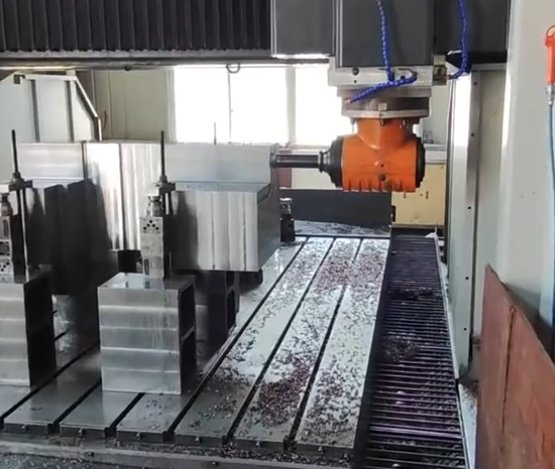
Large part CNC machining focuses on manufacturing oversized and heavy components with high precision using computer numerical control equipment. It supports industries that rely on big, complex parts such as construction machinery, energy generation, mining, marine, aerospace tooling, rail, and industrial equipment.
What Is Large Part CNC Machining
Large part CNC machining is the process of cutting, shaping, drilling, and finishing workpieces with dimensions or weight beyond the capability of standard machine tools. These operations use large-format CNC vertical and horizontal machining centers, boring mills, and gantry mills to generate accurate features on long, wide, or tall components.
Compared with conventional machining, large part machining must manage higher loads, longer travel distances, and more complex fixturing. Despite the scale, the objective is the same: produce parts that meet exact dimensional, geometric, and surface finish requirements repeatedly.
Typical Industries and Applications
Large CNC machined parts are essential in multiple industrial sectors where structural strength, reliability, and precise fit-up are critical.
- Construction and earthmoving machinery: frames, booms, housings, track components
- Energy and power generation: turbine housings, generator frames, gearboxes, bearing supports
- Oil and gas: riser components, valve bodies, manifolds, subsea structures
- Marine and shipbuilding: propeller hubs, rudder components, winch bases, deck machinery parts
- Mining and material handling: crusher housings, mill bases, conveyor structures, rotary equipment
- Rail and transportation: bogie frames, coupler parts, wheel hubs, brake components
- Industrial machinery: press frames, machine bases, columns, precision weldments
- Aerospace tooling and molds: large lay-up tools, forming dies, fixtures, assembly jigs
Key Capabilities in Large Part Machining
When evaluating large part CNC machining, several capability areas define what a shop can reliably deliver.
Maximum Part Size and Weight
Each machine has limits on X, Y, Z travels and table or fixture capacity. These parameters determine if a component can be machined in one setup or must be processed in multiple operations.
| Capability | Common Range | Notes |
|---|---|---|
| Maximum X travel | 1,500–12,000 mm | Horizontal boring mills and gantry mills cover long components |
| Maximum Y travel | 800–4,000 mm | Determines width capacity and cross-travel reach |
| Maximum Z travel | 800–3,000 mm | Critical for tall parts and deep features |
| Table load capacity | 3–60 metric tons or more | Defines maximum workpiece weight including fixtures |
| Spindle power | 20–60 kW | Higher power supports heavy cutting in tough materials |
| Spindle speed | 2,500–10,000 rpm | Balanced for roughing removal and finishing quality |
Actual values vary widely; a suitable provider will match machine capacity to part dimensions, considering setup clearances and tool lengths, not just nominal travels.
Tolerances and Geometric Accuracy
Large does not mean imprecise. Large part CNC machining routinely achieves tight tolerances over extended distances, provided that machines are properly maintained, aligned, and compensated for temperature effects.
Typical tolerance bands for large components include:
- General machining on large frames: ±0.10–0.50 mm
- Machined bores, fits, and contact faces: ±0.01–0.05 mm
- Flatness and straightness on long faces: 0.02–0.10 mm per meter, depending on rigidity and inspection capability
- Positional tolerances of critical holes: 0.02–0.10 mm true position (often validated with CMM)
For functional assemblies, geometric dimensioning and tolerancing (GD&T) is commonly applied to control parallelism, perpendicularity, cylindricity, concentricity, and position over large spans.
Vertical and Horizontal Machining for Large Parts
Large part machining typically uses a combination of vertical and horizontal configurations to access features efficiently.
Vertical machining centers (VMCs) for large parts are suited to plate-like structures and tall components clamped on their base. Benefits include easy loading by crane, good visibility during setup, and efficient contouring across large top surfaces. They are widely used for:
- Large plates, bases, and frames
- Machining of slots, pockets, and surface profiles
- Large molds and dies
Horizontal machining centers (HMCs) and horizontal boring mills offer superior chip evacuation and multi-side access. A rotary table or multi-pallet system enables machining on several faces in fewer setups. Applications include:
- Thick housings and gearboxes
- Deep bores and intersecting holes
- Complex weldments requiring many machined faces
Gantry or portal mills cover very long or wide components such as machine beds and structural beams. Many large part machining projects combine vertical, horizontal, and gantry operations for optimal coverage and accuracy.
Single-Setup Versus Multi-Setup Machining
Whenever possible, large parts are machined in a single setup to preserve datums and reduce alignment work. However, component size, geometry, and machine limits may require multiple setups or repositioning. Effective process planning defines datum schemes and clamping strategies to maintain dimensional relationships across all operations.
Materials for Large CNC Machined Components
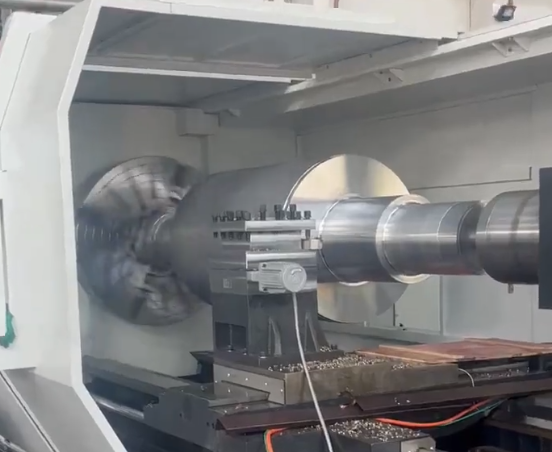
Large part machining covers a broad material range, from low carbon steels to advanced alloys. Material selection is driven by strength, stiffness, corrosion resistance, weight, and cost requirements.
| Material Group | Typical Grades | Typical Uses in Large Parts |
|---|---|---|
| Carbon steels | ASTM A36, AISI 1018, 1020, 1045 | Machine frames, brackets, plates, structural components |
| Alloy steels | 4140, 4340, 8620, quenched and tempered steels | Shafts, gears, high-load housings, wear components |
| Stainless steels | 304, 316, 410, 420, duplex grades | Corrosion-resistant marine, energy, and process equipment |
| Cast irons and ductile irons | GG25, GGG40, GGG60, ASTM A536 | Machine beds, housings, large bearing supports, pump bodies |
| Aluminum alloys | 5083, 6061, 6082, 7075 | Lightweight frames, aerospace tooling, structures |
| Non-ferrous metals | Brass, bronze, copper alloys | Bushings, wear plates, hydraulic and valve components |
| Tool steels | P20, H13, other mold and die steels | Large molds, dies, and forming tools |
The machinability of large sections is influenced by internal stresses, heat treatment condition, and casting or forging quality. For long or asymmetric parts, controlled rough machining followed by stress relieving and finish machining helps maintain dimensional stability.
Process Flow for Large Part CNC Machining
Large part projects benefit from a structured process flow to manage complexity and ensure repeatable results.
1. Design Review and Manufacturability Assessment
Before machining begins, the service provider reviews 3D models and drawings to check:
- Feasibility within machine size and travel limits
- Access to all features using available tools
- Datum and tolerance schemes relative to fixturing possibilities
- Material condition and required allowances
Recommendations may include adjusting tolerance zones, introducing machining allowances, or modifying non-critical features to simplify setups.
2. Fixturing and Workholding Planning
Fixturing is especially important for large parts due to weight and potential deflection. Typical approaches include:
- Dedicated steel fixtures bolted to machine tables
- Modular fixturing systems with adjustable supports
- Support jacks and adjustable rests to prevent sagging
- Clamping sequences that avoid distortion and preserve datums
For large weldments, fixture design must also support alignment during welding and subsequent machining.
3. CNC Programming and Toolpath Strategy
CAM software generates toolpaths that account for long travels, potential collisions with clamps or supports, and efficient chip removal. Strategies include:
- Layered roughing passes to remove bulk material without overloading the structure
- Adaptive or high-efficiency milling where machine capability allows
- Segmented machining areas to control thermal input and distortion
- Toolpath smoothing and corner rounding to minimize sudden load changes
4. Setup, Alignment, and Datum Control
Setup involves careful alignment of the workpiece on the machine table. Common practices include:
- Using reference surfaces from fabrication or casting as initial datums
- Checking straightness and flatness with dial indicators and laser systems
- Using probing cycles to locate features and verify alignment
Consistent datum references are maintained through all subsequent operations to ensure assembly fit.
5. Rough Machining, Stress Relief, and Finish Machining
Many large parts undergo staged machining. A common sequence is:
- Rough machining: remove the majority of excess material, leaving stock for finishing
- Stress relief: heat treatment to reduce residual stresses from welding, casting, or rough machining
- Finish machining: final passes to achieve required dimensions, geometry, and surface finish
This approach improves dimensional stability, especially for long beams, large weldments, and heavily machined castings.
6. Inspection, Assembly Checks, and Documentation
Inspection methods for large machined parts may involve:
- Coordinate measuring machines (CMM), bridge or portable
- Laser trackers and scanning systems for large distances and complex profiles
- Precision levels, autocollimators, and dial indicators for straightness and parallelism
- Functional gauges and test assemblies for critical fits
Measurement reports are often linked to serial numbers, material certificates, and process records for full traceability.
Vertical and Horizontal Large Part Machining in Detail
Vertical and horizontal machining configurations each offer specific advantages for large components. Understanding their differences helps in defining process routes and selecting a service provider.
Vertical Large Part Machining
Vertical large-format machining centers and gantry mills position the spindle above the part. Key aspects include:
- Workpiece support: large tables or floor plates that accept heavy clamping loads
- Accessibility: suitable for large planar surfaces and pockets
- Coolant and chip control: gravity assists chip evacuation from cavities, supported by coolant flow
Vertical machining is frequently used for:
- Structural plates and ribs
- Large surface milling of reference planes
- Machining T-slots, keyways, and mounting faces
Horizontal Large Part Machining
Horizontal machining centers and boring mills mount the spindle horizontally, allowing chips to fall away from the cut and enabling multi-side machining. Features include:
- Rotating tables or pallets for 4-axis or 5-axis processing of multiple faces
- Deep bore capability with extended quills or boring bars
- Better access to internal features and intersecting passages
Horizontal machining is preferred for block-shaped parts, heavy housings, and components that require accurate relationships between many faces or bores.
Combining Vertical and Horizontal Operations
Complex large parts often benefit from a mixed approach: vertical machining for faces and profiles, followed by horizontal machining for bores and side features. Careful datum planning ensures that both sets of operations reference the same coordinate system, preserving positional accuracy.
Surface Finishes and Feature Types
Large part CNC machining produces a wide variety of surfaces and features. Surface finish is tailored to functional requirements such as sliding contact, sealing, paint adhesion, or weld preparation.
Typical finish levels include:
- Rough-machined surfaces: Ra 3.2–6.3 μm for non-critical areas
- Precision bearing or sealing surfaces: Ra 0.4–1.6 μm
- Preparation for coating or painting: controlled roughness for adhesion
Common features on large parts include:
- Machined pads and mounting faces
- Bored holes, bearing seats, and shaft interfaces
- Threaded holes and studs, often in high quantity
- Grooves, slots, and keyways
- Pockets and cavities for weight reduction or functional integration
Quality Control and Inspection in Large Part Machining
Accurate measurement of large components requires appropriate equipment, procedures, and environmental control. Quality control is integral throughout the machining process.
Measurement Equipment and Methods
Inspection of large parts may involve one or more of the following tools:
- Bridge or gantry CMMs for high accuracy on large envelopes
- Portable CMM arms for flexible probing on the shop floor
- Laser trackers for long-distance measurements, alignments, and best-fit analysis
- Height gauges, micrometers, bore gauges, and surface roughness testers
- Dial indicators mounted on magnetic bases or special supports for alignment checks
Environmental and Process Controls
For tight tolerances, temperature control and process consistency are significant. Practices include:
- Allowing large parts to stabilize to shop temperature before final machining and inspection
- Monitoring ambient conditions when measuring long distances
- Using consistent clamping conditions when repeating measurements
Dimensional data can be recorded in digital formats to support traceability, statistical analysis, and customer documentation requirements.
Common Considerations in Large Part Machining
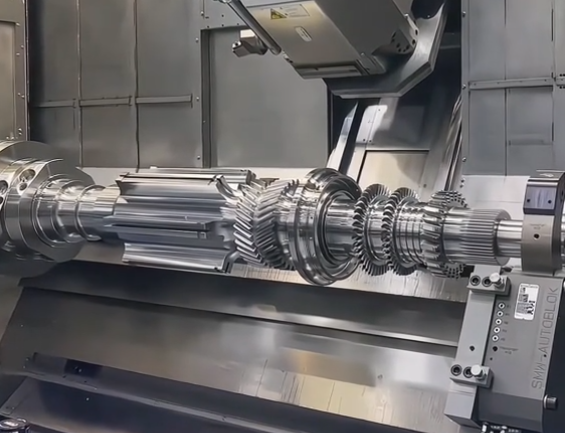
Large part CNC machining introduces practical considerations beyond those encountered with smaller components. Addressing them early contributes to reliable outcomes.
Workpiece Handling and Logistics
Heavy components require cranes, forklifts, or specialized lifting equipment. Planning includes:
- Lifting points and rigging methods that avoid distortion
- Safe part rotation between vertical and horizontal orientations
- Transport fixtures or skids that support the part during shipping
Distortion Management
Due to size, mass distribution, and previous forming or welding operations, large parts can be sensitive to distortion. To control this, machining processes may:
- Use symmetrical material removal where possible
- Apply intermediate stress relief treatments
- Include straightening operations if necessary
Design and process teams can work together to define machining allowances and sequence operations that minimize residual stresses.
Tool Selection and Tool Life
Cutting tools for large-part machining must handle extended engagement times and varying loads. Considerations include:
- Indexable milling cutters and boring tools for economical insert changes
- Carbide grades matched to material type and cutting conditions
- Coolant delivery for deep pockets and bores
- Tool length and rigidity, particularly on tall setups
Additional Services Around Large Part Machining
Many large part machining providers offer related services to deliver more complete components or assemblies.
Welding and Fabrication
Large weldments are often machined after fabrication to achieve accurate interfaces. Services can include:
- Steel and stainless steel welding for frames and structures
- Pre-machining of components for weld fit-up
- Post-weld stress relief before final machining
Heat Treatment
Heat treatment can increase strength, wear resistance, or dimensional stability. Typical treatments involve:
- Normalizing and annealing of steel castings and forgings
- Quench and temper for alloy steels
- Stress relieving after heavy welding or rough machining
Surface Treatment and Coating
After machining, parts may receive surface protection or enhancement such as:
- Shot blasting or bead blasting to prepare surfaces
- Painting, powder coating, or other protective coatings
- Plating or other metal treatments, where applicable
Subassembly and Integration
Some providers perform partial assembly, including installing bearings, bushings, seals, and fasteners, or test-fitting mating components. This reduces handling and coordination for the end customer.
Selecting a Large Part Machining Partner
Choosing an appropriate large part machining supplier requires evaluation of their technical capability, process control, and ability to support your project requirements.
Technical and Machine Capabilities
Key points to confirm include:
- Available machine types: vertical, horizontal, boring mills, gantry mills
- Maximum part dimensions and weight they can handle
- Tolerance levels they routinely achieve on similar parts
- Materials they regularly machine and any specialization
Quality Systems and Certification
Quality standards and certifications demonstrate the ability to maintain consistent processes. Consider:
- Formal quality management systems such as ISO 9001 or equivalent
- Calibration programs for measurement equipment
- Documented inspection procedures and reporting formats
Project Management and Communication
Large components often carry long lead times and multiple process stages. Effective project management and communication support on-time delivery and clear expectations.
Cost and Lead Time Considerations
Large part machining cost is influenced by material, complexity, time in machine, fixturing requirements, and additional processes such as welding or heat treatment. Transparent quotations that detail assumptions and process steps help align budgets with requirements.
Why Choose XCM for Large CNC Machining?
There are plenty of machining suppliers in the market. Here’s why clients choose XCM for large CNC machining projects:
● Advanced large-format CNC equipment (gantry mills, horizontal boring mills, VTLs)
● Integrated fabrication, welding, and machining capabilities
● Tight tolerance control on long-span and high-mass parts
● Competitive pricing with scalable production capacity
● Rapid turnaround for prototypes and urgent projects
● Strict quality inspection with CMM and in-process verification
● Optimized fixturing and tooling for maximum rigidity and stability
We combine large-scale machining capacity with practical manufacturing engineering. That integration reduces dimensional risk, improves process efficiency, and accelerates time to market for complex, oversized components.
FAQ
What is large part CNC machining?
Large part CNC machining refers to precision machining processes used to manufacture oversized components—typically exceeding standard machine travel limits—using heavy-duty CNC mills, lathes, or gantry systems designed for high rigidity and long-axis travel.
What size qualifies as a “large part” in CNC machining?
While definitions vary by shop capability, large parts generally exceed 1 meter (40 inches) in one or more dimensions or weigh several hundred kilograms to multiple tons.
What materials are typically machined in large part CNC projects?
Common materials include carbon steel, alloy steel, stainless steel, aluminum alloys, cast iron, titanium, and specialized engineering plastics or composites.
What are the key challenges in machining large parts?
Major challenges include maintaining dimensional accuracy over long spans, minimizing thermal distortion, ensuring rigidity, handling heavy material safely, and managing chip evacuation.
How long does large part CNC machining typically take?
Lead times vary based on complexity, material, and finishing requirements but typically range from several days to several weeks.