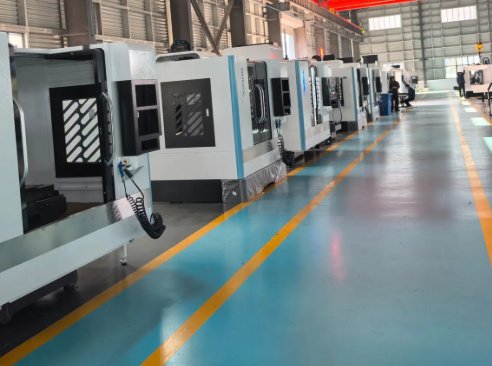
China CNC machining, often referred to as Chinese CNC services, has become a central manufacturing option for companies that need precise, repeatable, and cost-effective metal and plastic parts. This guide explains the fundamentals, technical features, and a practical process to work with CNC machining suppliers in China.
What Is China CNC Machining
China CNC machining is the use of computer numerical control (CNC) machine tools operated by manufacturers in China to produce precision components from metals, plastics, and other engineering materials. It covers CNC milling, CNC turning, drilling, boring, tapping, and related secondary operations.
In a China-based CNC shop, CAD models are converted into CNC programs (usually G-code). These programs drive multi-axis machine tools to cut material from solid stock (bars, plates, blocks, castings, forgings) into finished parts with tight dimensional control.
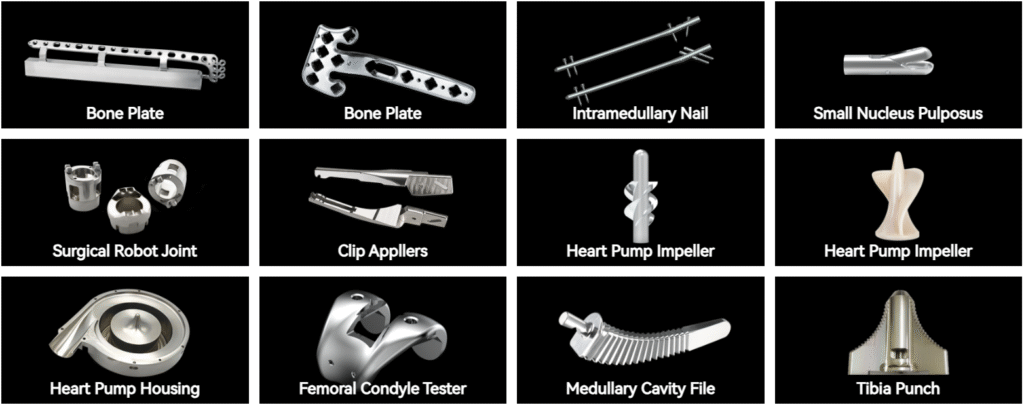
Chinese CNC machining is widely used for rapid prototypes, low-to-medium volume production, and high-volume components that require accuracy, especially in automotive, industrial equipment, consumer electronics, robotics, medical devices, and aerospace subcomponents.
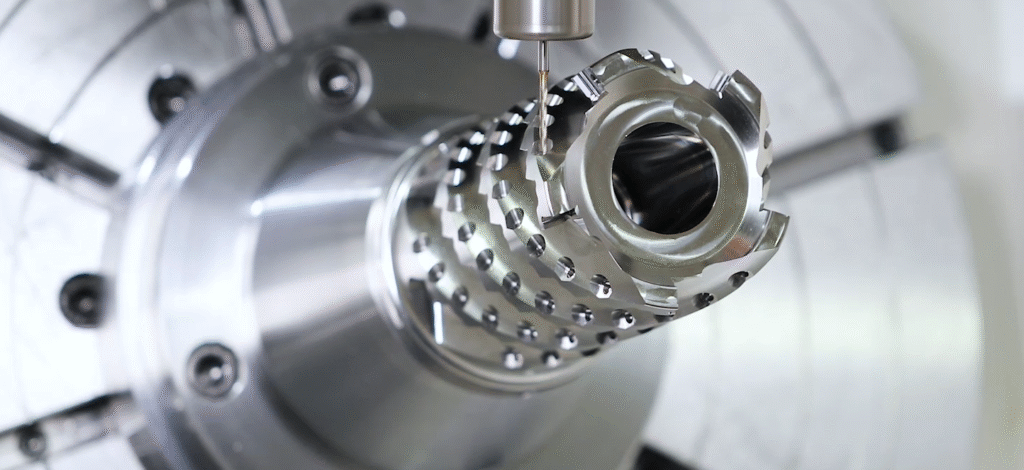
Core Processes in Chinese CNC Machining
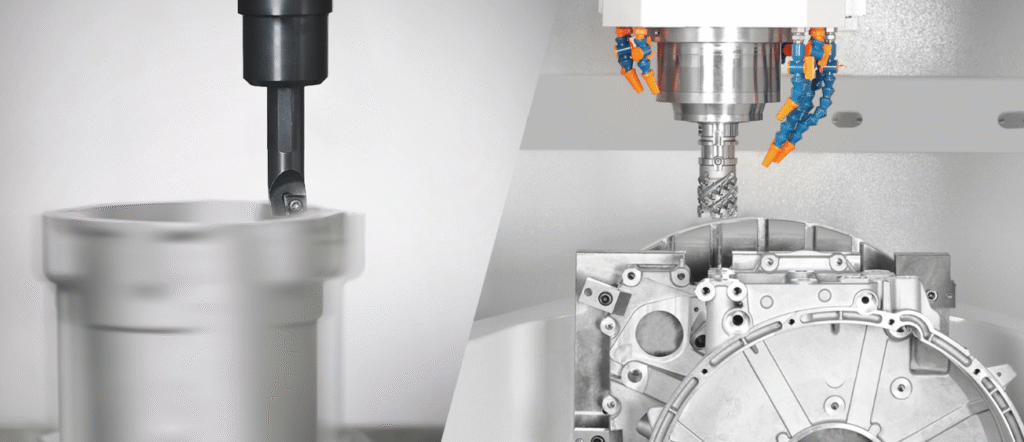
Most China CNC machining providers offer a combination of milling, turning, and drilling processes, often integrated in multi-tasking machines or automated cells. Understanding these core processes helps you design parts that are manufacturable and cost-efficient.
CNC Milling
CNC with a rotating cutting tool. The workpiece is usually fixed on a table while the cutter moves in multiple axes. Typical configurations in Chinese CNC shops include 3-axis, 4-axis, and 5-axis vertical or horizontal machining centers.
- 3-axis milling: X, Y, Z linear motion; suitable for prismatic parts, simple contours, pockets, and holes.
- 4-axis milling: adds rotary motion, usually around the X-axis (A-axis) or Y-axis (B-axis), enabling machining on multiple faces without re-clamping.
- 5-axis milling: simultaneous multi-axis cutting, ideal for complex surfaces, undercuts, and parts that need access from several directions in one setup.
Typical milling operations in Chinese CNC machining include face milling, contouring, pocketing, slotting, drilling, tapping, thread milling, and engraving.
CNC Turning
CNC turning rotates the workpiece while stationary cutting tools remove material. It is ideal for cylindrical and rotational components such as shafts, bushings, fittings, and housings. China CNC turning shops often use 2-axis lathes and multi-axis turn-mill centers.
Common operations:
- External and internal turning
- Facing and grooving
- Threading (metric, UNC/UNF, custom)
- Boring and drilling on the spindle
For parts requiring both turning and milling (e.g., hex features on a shaft), Chinese suppliers frequently use turn-mill centers with live tooling and sub-spindles to reduce setups and improve accuracy between features.
Drilling, Boring, and Tapping
Beyond milling and turning, Chinese CNC machine shops routinely perform drilling, boring, reaming, and tapping, either on dedicated equipment or integrated into machining centers. This enables them to produce complex hole patterns, threaded holes, and precision bores in one clamping, improving positional accuracy.
Materials Commonly Used in China CNC Machining
China CNC machining services cover a broad spectrum of metals, alloys, and plastics. The choice depends on mechanical, thermal, chemical, and regulatory requirements.
| Category | Typical Grades | Key Properties | Common Applications |
|---|---|---|---|
| Aluminum alloys | AL6061, AL6082, AL6063, AL7075, AL2024 | Lightweight, good machinability, moderate to high strength, good corrosion resistance | Enclosures, brackets, heat sinks, automotive parts, fixtures |
| Carbon steels | Q235, 1018, 1045, S235, S355 | High strength, cost-effective, requires corrosion protection | Mechanical components, shafts, couplings, structural parts |
| Alloy steels | 4140, 42CrMo, 40Cr, 4340 | High strength and toughness, heat-treatable, wear resistant | Gears, heavy-duty shafts, tooling, high-load components |
| Stainless steels | 303, 304, 316, 316L, 17-4PH | Corrosion resistant, some are hardened, suitable for food and medical | Fasteners, medical parts, food equipment, marine components |
| Copper and brass | H62, C3604, C110, C2680 | Excellent electrical conductivity, good machinability (brass), good corrosion resistance | Electrical components, connectors, valves, decorative parts |
| Tool steels | D2, SKD11, H13, P20 | High hardness, wear resistance, heat-resistant (for hot-work grades) | Molds, dies, cutting tools, wear plates |
| Titanium alloys | TC4 (Ti-6Al-4V), TA2 | High strength-to-weight ratio, corrosion-resistant, biocompatible | Aerospace components, medical implants, high-performance parts |
| Engineering plastics | ABS, PC, POM (Delrin), PA (Nylon), PEEK, PTFE | Lightweight, electrical insulation, chemical resistance, varying strength and temperature resistance | Prototypes, insulators, gears, bushings, medical housings |
When sending RFQs to Chinese CNC shops, specifying exact international equivalents (e.g., EN, ASTM, JIS) and acceptable substitutes helps prevent material mismatches.
Dimensional Accuracy and Tolerances
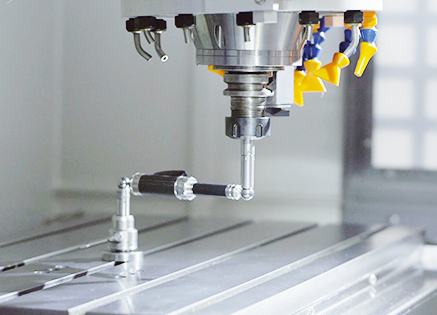
China CNC machining suppliers routinely achieve tight tolerances as long as the part design and material are suitable. Capability depends on machine type, process stability, and inspection methods.
Typical tolerance levels many Chinese CNC providers can offer:
- General CNC machining: ±0.10 mm to ±0.05 mm on linear dimensions.
- Precision features: ±0.02 mm to ±0.01 mm with appropriate fixturing and process control.
- Hole tolerances: H7, H8, or custom fits when reaming, boring, or honing is applied.
- Positional tolerance (true position): within 0.05–0.10 mm for moderate-sized parts when datums and fixtures are well defined.
For features requiring very tight tolerances, such as press fits or critical bearing seats, many Chinese CNC shops combine machining with grinding or honing to reach tighter geometrical tolerances (roundness, cylindricity, runout).
Surface Finish and Post-Processing Options
China CNC machining is often combined with surface finishing and post-processing services to deliver end-use components.
Machined Surface Roughness
Surface roughness values after CNC machining depend on the cutting tool, material, and cutting parameters. Common ranges:
- Standard milling or turning: Ra 3.2–1.6 μm.
- Fine finishing operations: Ra 1.6–0.8 μm or better with optimized tools and passes.
- Grinding: Ra 0.4–0.2 μm when specified.
When ordering from Chinese CNC suppliers, specify surface finish requirements using Ra values or equivalent standards and indicate which surfaces require enhanced finishes.
Typical Surface Treatments in China CNC Machining
Many China-based CNC shops either perform finishing in-house or work with local specialists. Common options include:
- Anodizing (Type II, hard anodizing) for aluminum.
- Electroplating (zinc, nickel, chrome) for steels and brass.
- Powder coating and liquid painting.
- Black oxide for carbon steel.
- Passivation for stainless steel.
- Heat treatment (quenching, tempering, nitriding, carburizing) for steels and tool steels.
To avoid misunderstandings, define color codes (e.g., RAL or Pantone for coatings), minimum coating thickness, and functionality (decorative vs protective) in your RFQ and technical drawings.
Typical Part Sizes, Volumes, and Lead Times
China CNC machining shops vary widely in scale. Some focus on small precision components; others handle large structures and heavy castings.
| Aspect | Common Range | Notes |
|---|---|---|
| Part size (milling) | Up to approx. 1000 × 600 × 500 mm, some shops larger | Larger machining centers and gantry mills exist for big components |
| Part diameter (turning) | From micro parts up to approx. Ø400–600 mm | Heavy-duty lathes can handle larger diameters when required |
| Batch size | From single prototypes to tens of thousands of pieces | Many Chinese CNC providers specialize in low-to-medium volume runs |
| Prototype lead time | Approx. 3–10 working days after order confirmation | Depends on complexity, material availability, and finishing |
| Production lead time | Approx. 2–6 weeks for typical batches | Larger orders or special processes may require longer |
Lead times can be affected by material procurement, tooling preparation, heat treatment queues, surface finishing schedules, and shipping arrangements. Clarify your required delivery date and build this into the commercial agreement.
Design Considerations for Machining in China
Well-designed parts reduce machining time, cost, and risk of defects. When preparing designs for Chinese CNC machining providers, consider the following points.
Machinability and Geometry
Avoid unnecessarily complex geometries when simpler alternatives provide the same function. For instance:
- Minimize deep, narrow pockets with high aspect ratios.
- Use standard drill sizes for holes where possible.
- Prefer consistent wall thickness to avoid distortion.
For 3-axis milling, ensure that all required features are accessible from available orientations. If a part demands undercuts or complex 3D surfaces, clarify whether 4-axis or 5-axis capability is available at the chosen Chinese CNC supplier.
Tolerances and GD&T
Assign tight tolerances only to functionally critical dimensions. Over-constraining a drawing can increase cycle time and inspection effort. Use geometric dimensioning and tolerancing (GD&T) to define relationships among features clearly, especially for:
- Datum references for functional interfaces.
- Positional accuracy of hole patterns.
- Flatness and perpendicularity of mounting surfaces.
Provide 2D drawings even when 3D models are supplied, as many Chinese CNC machine shops rely on drawings for inspection and production documentation.
Material Specifications
Specify materials with precise standards (e.g., ASTM, EN, DIN, JIS, GB) and acceptable equivalents. For aluminum, indicate temper (e.g., 6061-T6). For steels, specify whether heat treatment is required and the target hardness range (e.g., HRC 50–55). This reduces ambiguity and supports accurate quoting.
Quality Control in Chinese CNC Machining
Reliable China CNC machining suppliers apply structured quality control (QC) processes. Understanding these processes helps you evaluate potential partners and ensure that delivered parts match specifications.
Incoming Material Inspection
Good Chinese CNC shops verify incoming raw materials by checking material certificates (e.g., Mill Test Reports) and, where necessary, performing hardness tests or spectrometer analysis. This ensures the chemical composition and mechanical properties meet requirements.
In-Process and Final Inspection
Typical inspection steps include:
- First Article Inspection (FAI) for new parts or revisions.
- In-process checks at defined intervals (e.g., every specified quantity or time period).
- Final inspection before packaging and shipment.
Inspection equipment often used by Chinese CNC machining providers includes:
- Digital calipers, micrometers, height gauges, bore gauges.
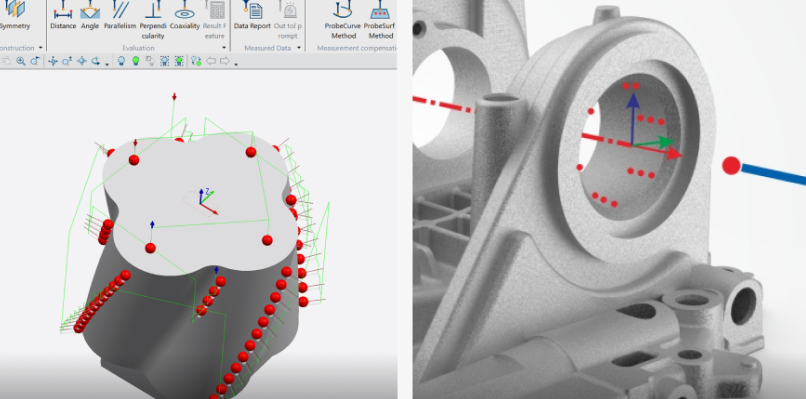
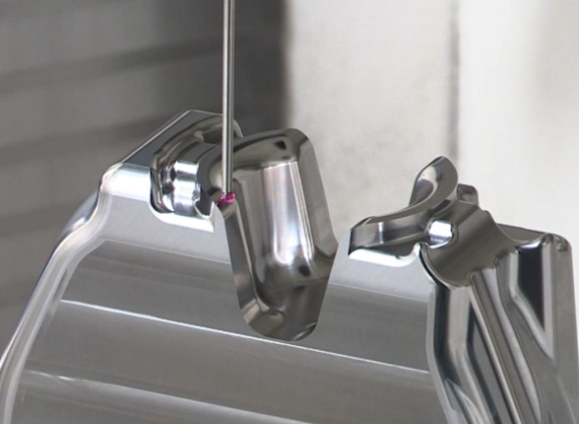
- Coordinate Measuring Machine (CMM) for complex geometries.
- Optical projectors and vision systems for small or intricate features.
- Surface roughness testers and hardness testers where required.
For critical projects, request documented inspection reports, including dimension lists, sampling plans, and any non-conformance records. Clearly specify whether 100% inspection or sampling inspection is expected and which dimensions are critical-to-quality (CTQ).
Common Issues and Practical Considerations
When working with Chinese CNC machining suppliers, several practical issues frequently appear. Addressing them early helps avoid delays and rework.
Technical Communication
Although many China CNC machining companies employ English-speaking sales engineers, differences in terminology and drawing standards can cause misunderstandings. Use unambiguous dimensioning, provide 3D models and 2D drawings, and respond promptly to clarification questions. Sharing reference samples or photos for complex features can also improve communication.
Tolerance Interpretation
Different machining cultures may interpret unspecified tolerances differently. If general tolerances (e.g., ISO 2768-m) are required, indicate them clearly on the drawing. For unmarked dimensions, define default tolerances in a general note to prevent assumptions that are too loose or too tight.
Packaging and Protection
Packaging has a direct impact on surface quality and corrosion resistance during transportation. For machined parts shipped internationally, confirm packaging methods, such as:
- Use of anti-rust oil or VCI bags for steel parts.
- Individual wrapping or separators to avoid metal-to-metal contact.
- Use of foam, blister trays, or custom inserts for delicate surfaces.
Clear packaging instructions help reduce scratches, dents, and corrosion.
Step-by-Step: How to Get Started with China CNC Machining
The following structured process can guide you from initial design to receipt of parts when working with China CNC machining and Chinese CNC suppliers.
1) Define Technical Requirements
Before contacting suppliers, organize:
- 3D CAD models in standard formats (STEP, IGES, Parasolid).
- 2D drawings with dimensions, tolerances, material, hardness, and finishes.
- Expected quantities (prototype, pilot run, and long-term annual volumes).
- Target lead time and any certification requirements (e.g., material certificates, RoHS).
Consolidating this information allows China CNC machining providers to quote faster and more accurately.
2) Shortlist Chinese CNC Suppliers
Identify potential Chinese CNC machining shops based on:
- Process capability: milling, turning, 5-axis machining, grinding, etc.
- Experience with similar parts or industries.
- Quality certifications such as ISO 9001, IATF 16949 (for automotive), or ISO 13485 (for medical).
Check their machine lists, sample parts, and basic QC equipment. Suppliers with documented experience in your material and tolerance range are generally preferable.
3) Request for Quotation (RFQ)
Submit RFQs with detailed information to each shortlisted Chinese CNC shop. Include:
- Drawings and 3D models with revision numbers.
- Material specification and any acceptable alternatives.
- Special requirements such as specific brand materials, heat treatment, or surface finish.
- Inspection level and any sampling standards (e.g., AQL levels).
- Packaging instructions and shipment terms (e.g., FOB, CIF, DAP).
Request a breakdown of price per part, tooling or fixture costs, lead time, and payment terms. This makes offers comparable across different Chinese CNC providers.
4) Evaluate Quotes and Technical Responses
When evaluating quotations from China CNC machining suppliers, consider:
- Unit price at your required quantities.
- Lead time and production capacity.
- Supplier questions that demonstrate technical understanding.
- Proposed process (machines, setups, finishing steps) when available.
Technical responsiveness is an indicator of how they will handle issues later. Clarify any missing or unclear points before selecting a supplier.
5) Place a Trial Order or First Article
For new parts, many buyers place a smaller trial order or a formal First Article Inspection (FAI) batch. This allows you to:
- Verify dimensional accuracy and surface finish on real parts.
- Assess packaging quality and documentation.
- Confirm actual lead time performance.
Provide consolidated feedback to the Chinese CNC machining supplier, listing deviations, approved deviations, and any requested design adjustments.
6) Ramp Up to Regular Production
Once first articles are approved, establish regular production parameters:
- Standard order quantities and delivery schedules.
- Agreed sampling plans for ongoing quality checks.
- Communication channels for engineering changes and corrective actions.
Consistent purchase patterns and clear documentation support stable production and help the China CNC machining provider maintain dedicated tooling, fixtures, and process settings for your parts.
Cost Drivers in China CNC Machining
Understanding cost drivers helps you design parts and choose processes that meet both technical and budgetary constraints when working with Chinese CNC suppliers.
Material and Stock Size
Material cost includes both the raw material price and the amount of waste. Oversized stock and exotic alloys significantly raise costs. Design parts to use readily available stock sizes and materials that are common in the Chinese market when possible.
Machining Time and Setup
Each change of setup, fixture, or tool adds time. Parts requiring many orientations, special fixtures, or extremely tight tolerances will take longer and cost more. Simplifying geometry, reducing the number of critical surfaces, and standardizing features can lower machining time.
Finishing and Inspection Requirements
Additional surface treatments, heat treatments, or extensive inspection (e.g., 100% CMM measurement) influence the total cost. Define these requirements according to functional needs and avoid unnecessary steps. Discuss with the Chinese CNC machining supplier whether some finishes can be combined or optimized.
Documentation and Traceability
Documentation preserves consistency and traceability across batches produced by China CNC machining suppliers.
Technical Documentation
Provide and maintain up-to-date:
- Revision-controlled drawings and 3D models.
- Process notes for special operations or assembly interfaces.
- Specifications for acceptable deviations and form/fit/function criteria.
When revising designs, clearly mark changes and communicate effective dates and transition plans for old and new versions.
Quality and Material Records
Depending on your industry, you may require suppliers to retain:
- Material certificates and heat numbers.
- Inspection reports and test records.
- Non-conformance reports and corrective action records.
Agree on retention times and format (digital vs paper). For safety-critical components, ensure traceability from raw material to final part via batch or serial numbering.

XCM – Your Trusted China CNC Machining Partner
Looking for high-quality, cost-effective CNC machining without compromising on speed or precision? XCM delivers world-class China CNC machining services that combine cutting-edge technology, decades of engineering expertise, and unbeatable Asian manufacturing advantages.From prototypes to high-volume production, we specialize in precision milling, turning, 5-axis machining, Swiss-type machining, and complex multi-axis parts in materials ranging from aluminum and stainless steel to titanium and engineering plastics. With ±0.005 mm tolerances, ISO 9001 & IATF 16949 certification, and full material certifications + inspection reports on every order, XCM guarantees parts that meet the strictest aerospace, medical, automotive, and robotics standards. XCM – Precision Made Affordable. Made in China, Trusted Worldwide.
FAQ: China CNC Machining and Chinese CNC Services
What is China CNC machining?
China CNC machining refers to the manufacturing process in China where computer-controlled machines produce precise parts from various materials, including metals, plastics, and composites. China has become a popular destination due to cost efficiency, high-quality production, and flexible manufacturing capabilities.
What types of CNC services are available in China?
Chinese CNC service providers offer a wide range of services including CNC milling, CNC turning, CNC drilling, CNC grinding, laser cutting, and custom prototyping. Many companies can handle both small-batch prototypes and large-scale production runs.
Why choose CNC machining services from China?
China CNC services are often chosen for competitive pricing, access to experienced manufacturers, fast lead times, and the ability to handle complex geometries. Many suppliers also provide additional support like design optimization, quality control, and global shipping.
How can I ensure the quality of Chinese CNC machined parts?
To ensure quality, request certifications (ISO, TS, or similar), review supplier quality control procedures, ask for sample parts or prototypes, and maintain clear communication on material and tolerance requirements. Many reputable Chinese CNC suppliers also offer in-process inspections and final reports.