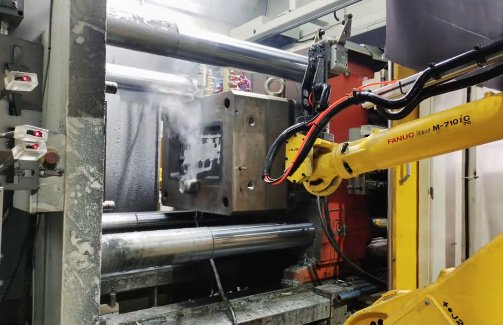
Aluminum Alloy A380 is widely regarded as the workhorse of die casting alloys, accounting for roughly 80–85% of aluminum die-cast production. Its popularity stems from an effective balance of:
- Excellent fluidity and castability
- Good strength-to-weight ratio
- Suitable for complex geometries
- Moderate corrosion resistance
- Cost efficiency
A380 is generally considered a moderately abrasive but highly machinable aluminum alloy. However, while A380 performs exceptionally well in casting, its machining behavior is strongly influenced by its microstructure and inherent casting defects. This article provides a practical, engineering-focused overview of how A380 behaves in machining environments and how to optimize processes around it.
Material Overview and Microstructure
A380 Aluminum is an Al-Si-Cu (3xx.x series) alloy. Its microstructure typically consists of:
- Primary aluminum dendrites
- Al-Si eutectic phases
- Al₂Cu intermetallic compounds
Additionally, die casting introduces:
- Gas porosity
- Shrinkage porosity
Machining Implications:
- High silicon content → increased tool wear
- Intermetallic phases → unstable cutting forces
- Porosity → surface defects and tool chipping
In practice, porosity is one of the main causes of inconsistent machining results in A380 components.
Chemical Composition and Metallurgical Impact
Typical composition ranges:
- Copper (Cu): 3–4%
- Iron (Fe): ≤1.3%
- Magnesium (Mg): ≤0.1%
- Manganese (Mn): ≤0.5%
- Nickel (Ni): ≤0.5%
- Silicon (Si): 7.5–9.5%
- Tin (Sn): ≤0.35%
- Zinc (Zn): ≤3%
- Aluminum (Al): Balance
| Element | Typical Range | Effect on Machining |
|---|---|---|
| Si | 7.5–9.5% | Increases abrasiveness |
| Cu | 3–4% | Improves strength, reduces corrosion resistance |
| Fe | ≤1.3% | Forms hard intermetallics |
| Mg | ≤0.1% | Minor strengthening |
| Zn | ≤3% | Affects ductility |
Key implications:
- High silicon content improves fluidity but increases abrasiveness
- Copper addition enhances strength and hardness but reduces corrosion resistance
This combination makes A380 Aluminum a moderately abrasive but stable machining material. High silicon content is the primary reason A380 causes faster tool wear compared to wrought alloys like 6061.
Mechanical and Physical Properties
Mechanical properties:
- Hardness: ~80 HB
- Ultimate tensile strength: ~324 MPa
- Yield strength: ~159 MPa
- Elongation: ~3.5%
Physical properties:
- Density: ~2.75 g/cm³
- Thermal conductivity: ~96 W/m·K
- Electrical conductivity: ~23% IACS
| Property | Value, metric | Value, Imperial |
|---|---|---|
| Density | 2.75 g/cm3 | 2.75 g/cm3 |
| Elongation at Break | 1% | 1% |
| Hardness | 60-80 | 60-80 |
| Ultimate Tensile Strength | 150-240 MPa | 22-35 ksi |
These properties support applications requiring thermal management, lightweighting, and structural integrity.
A380 vs. Other Alloys
This alloy is essentially the first consideration for many applications — what you might refer to as the ‘default.’ Depending on the requirements for your product, it can make sense to specify another alloy instead.
A380 vs 6061 Aluminum
| Property | A380 | 6061 |
|---|---|---|
| Machinability | Good | Excellent |
| Tool wear | High | Low |
| Surface finish | Moderate | Good |
| Production method | Die casting | Wrought |
A380 vs ADC12 (A383)
| Property | A380 | ADC12 |
|---|---|---|
| Fluidity | Good | Better |
| Machinability | Good | Slightly better |
| Crack resistance | Moderate | Higher |
Machinability of A380 Aluminum
A380 aluminum is widely regarded as a highly machinable die-cast alloy, making it a preferred choice for precision CNC machining services. Its balanced composition provides good strength, corrosion resistance, and thermal conductivity, while maintaining efficient machinability in high-volume production environments.
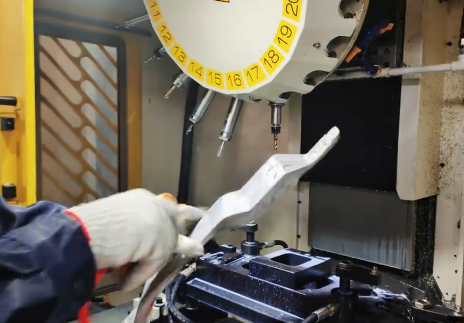
A380 aluminum machining performs particularly well in common CNC operations such as:
- Milling – smooth surface finishes and consistent dimensional accuracy
- Turning – stable cutting with minimal tool deflection
- Drilling – efficient chip evacuation under optimized conditions
- Tapping – reliable thread formation with proper lubrication
Higher cutting speeds improve productivity but accelerate tool wear due to silicon content.
Key Machining Characteristics
- Stable chip formation when proper cutting parameters are applied
- Excellent compatibility with high-speed machining (HSM)
- Suitable for thin-wall components and complex geometries
- Good dimensional stability in mass production
Factors Affecting Machinability
Despite its advantages, several material characteristics can influence machining performance:
- High silicon content may cause increased tool wear due to abrasive particles
- Presence of intermetallic phases can impact cutting consistency
- Internal porosity from die casting may affect surface integrity and tool life
- Variations in casting quality can lead to inconsistent machining results
Best Practices for Machining A380 Aluminum
- Use carbide or diamond-coated tools to reduce wear
- Optimize cutting speeds and feeds for high-efficiency machining
- Apply proper coolant or lubrication to improve surface finish
- Inspect castings for porosity before precision machining
Design for Machining (DFM) Considerations
Successful machining of A380 Aluminum components begins at the design stage, not on the shop floor.
Key considerations include:
- Machining allowances are applied to compensate for casting variability
- Dimensional tolerances are defined based on functional requirements
- Internal features such as porosity are considered during part design
- Trade-offs between casting complexity and machining effort are evaluated
From an engineering perspective, A380 Aluminum machining requires a DFM + DFC (Design for Casting) hybrid strategy, where:
- Overly complex cast geometry increases machining burden
- Tight tolerances demand secondary machining operations
- Porosity-sensitive areas must avoid critical sealing surfaces
Tooling Strategy
Tool materials:
- Polycrystalline diamond (PCD) — best for high-volume production
- Diamond-coated carbide — balance of cost and performance
- Carbide tools — general-purpose use
PCD tools provide the longest tool life when machining high-silicon aluminum alloys like A380.
Tool geometry:
- Sharp cutting edges
- High rake angles
- Polished flutes
These features reduce:
- Built-up edge (BUE)
- Cutting forces
- Surface defects
Common Machining Issues and Solutions
| Problem | Cause | Solution |
|---|---|---|
| Rapid tool wear | High silicon content | Use PCD tools |
| Poor surface finish | Porosity | Improve casting quality |
| Built-up edge (BUE) | Improper speed/feed | Increase cutting speed |
| Dimensional variation | Casting inconsistency | Add machining allowance |
Cutting Parameters and Process Optimization
Typical guidelines:
- High cutting speeds to improve productivity
- Moderate feed rates to maintain surface finish
- Optimized chip load for stability
Process parameters should be tuned based on:
- Tool material
- Operation type
- Part geometry
In high-volume environments, parameter optimization is often driven by tool life vs cycle time trade-offs.
Cooling and Lubrication Strategies
Common approaches include:
- Dry machining (clean, cost-effective)
- Minimum Quantity Lubrication (MQL)
- Flood coolant systems
Selection depends on:
- Surface finish requirements
- Environmental constraints
- Chip evacuation needs
MQL is often preferred in high-speed machining of A380 due to reduced thermal load and better tool life.
Surface Finishing and Post-Processing
Post-processing methods for A380 Aluminum machining include:
- Powder coating
- Shot blasting
- Polishing
These enhance:
- Surface aesthetics
- Corrosion resistance
- Functional performance
Industrial Applications
A380 Aluminum alloy is widely used across industries:
Automotive
- Engine components
- Transmission housings
- Structural brackets
Electronics
- Heat sinks
- LED housings
- Communication enclosures
Industrial Equipment
- Power tool housings
- Machinery components
Its combination of lightweight, strength, and thermal conductivity makes it ideal for high-volume manufacturing environments.
Conclusion
Aluminum Alloy A380 remains a foundational material in modern manufacturing due to its:
- Excellent castability
- Balanced mechanical properties
- Reliable machinability
However, optimal results require an integrated approach across design, casting, and machining. Engineers who account for microstructure, porosity, and process constraints early in development can significantly improve:
- Part quality
- Production efficiency
- Overall cost performance