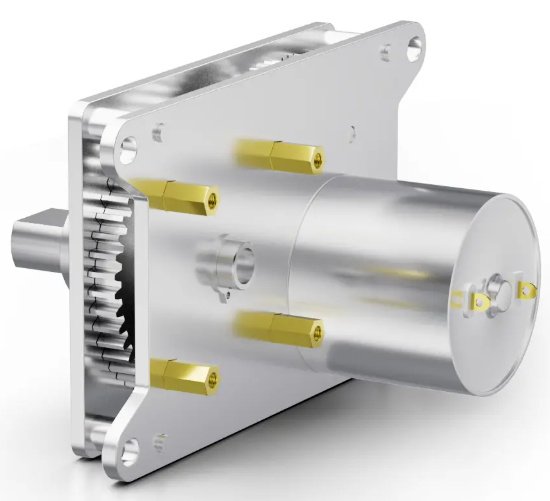
Overview of Actuators and CNC Machining
Actuators convert electrical, pneumatic, or hydraulic energy into mechanical motion. CNC machining is widely used to manufacture critical actuator components that require precise geometry, tight tolerances, and stable performance in demanding environments.
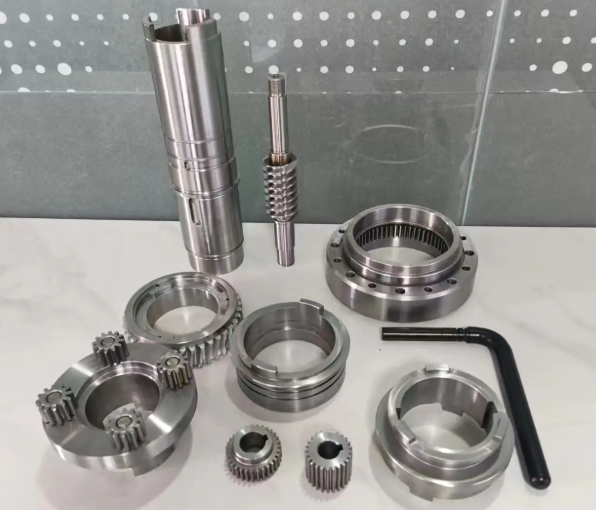
In actuator systems, CNC machining is typically applied to housings, shafts, pistons, end caps, mounting interfaces, and various precision transmission components such as ball screws and gear elements. The repeatability and dimensional control of CNC equipment support high-volume production and custom low-volume manufacturing for specialized actuator designs.
Main Types of Actuators Using CNC Machined Parts
Different actuator types impose different mechanical loads, sealing requirements, and geometric constraints on machined parts. Understanding the application helps define machining requirements.
Electric Linear Actuators
Electric linear actuators convert rotary motion of an electric motor into linear displacement through ball screws, lead screws, planetary roller screws, or other transmission mechanisms. CNC machining is essential for:
- Actuator body and mounting flanges
- Ball screw or lead screw shafts
- Nut housings and bearing supports
- End caps, covers, and cable entry interfaces
These parts require accurate alignment between motor, bearings, and driven rod to reduce friction, noise, and wear while maintaining repeatable positioning.
Electric Rotary Actuators and Servo Actuators
Rotary actuators and servo drives rely on CNC machined parts to hold bearings, stators, encoders, gears, and couplings. Key features often include precision bores, bearing seats, dowel pin holes, and tightly toleranced faces for gear and encoder alignment.
Pneumatic Actuators
Pneumatic cylinders and rotary pneumatic actuators use compressed air to provide motion and force. Machined components include:
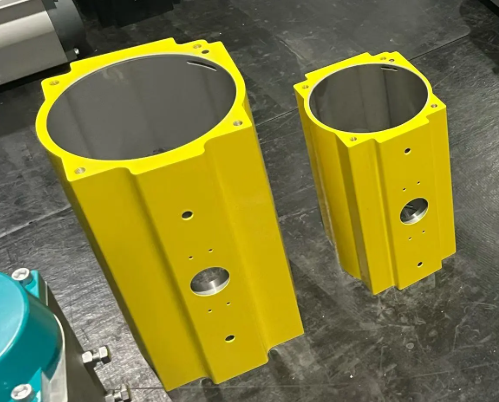
- Cylinder tubes or machined bores in aluminum or steel bodies
- Pistons with grooves for seals
- End caps with air ports and mounting interfaces
- Shafts, rods, and rotary vanes
Attention to surface finish and dimensional accuracy is important to ensure correct sealing, low leakage, and stable motion characteristics.
Hydraulic Actuators
Hydraulic cylinders and actuators operate at significantly higher pressures than pneumatic systems. CNC machining supports high-strength structures and controlled internal geometry, especially for:
High-pressure cylinder barrels, piston rods, glands, and end caps often require deep-hole machining, honed surfaces, and robust thread forms capable of withstanding both pressure and cyclic loading.
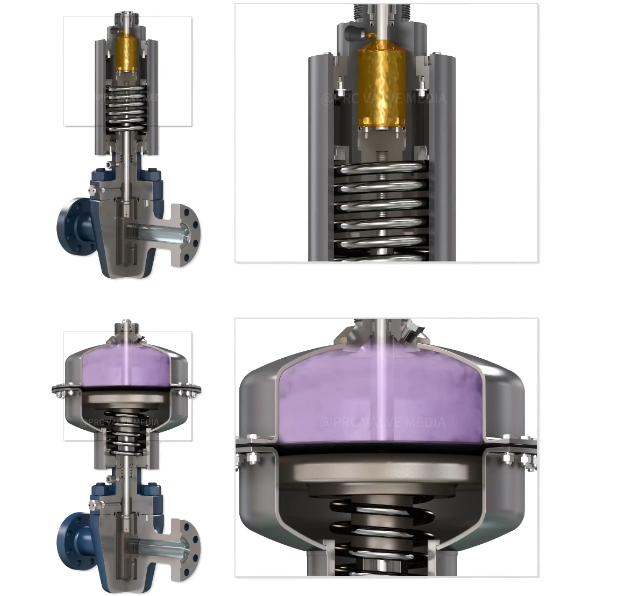
Key CNC Machined Components in Actuator Assemblies
Actuator performance depends strongly on how accurately the critical components are machined and assembled. The functional interfaces between parts must be tightly controlled to prevent binding, leakage, misalignment, or premature wear.
Housings and Bodies
Actuator housings provide structural integrity, alignment, and protection for internal components. CNC machining is used to create:
- Precision bores for bearings, seals, and piston assemblies
- Mounting faces and pilot diameters for interface to machinery
- Port connections for fluid or air inlets and outlets
- Internal pockets and channels for components and fluid flow
The straightness and coaxiality of bores and features strongly affect friction, leakage, and service life.
Shafts, Rods, and Pistons
Shafts and rods transmit motion and force. CNC turning and grinding are applied to achieve accurate diameter, roundness, and surface roughness. Pistons require concentric grooves for seals, tight tolerance on outer diameter for clearance in the cylinder, and precise flatness of faces.
Ball Screws, Lead Screws, and Nut Components
Precision screws and nuts are essential elements in electric linear actuators for accurate positioning and force transmission. CNC milling, turning, and thread grinding can be used to produce screw shafts, while nut bodies and support structures are typically machined from bar or billet stock.
End Caps, Glands, and Covers
End caps support seals, bearings, and fastening features. Their flatness, perpendicularity, and thread accuracy are important for preload, sealing, and alignment. Glands in hydraulic actuators support rod seals and wipers, requiring tight tolerance grooves and bore diameters.
Mounting Interfaces and Brackets
Mounting brackets, clevises, trunnions, and flanges enable actuators to connect to equipment. CNC machining ensures consistent center distances, hole patterns, and alignment, avoiding stress concentrations and undesirable side loads.
Materials for CNC Machined Actuator Parts
Material selection for actuator components must consider mechanical strength, corrosion resistance, weight, cost, machinability, and compatibility with operating media. Common materials include aluminum alloys, carbon steels, alloy steels, stainless steels, brass, bronze, and engineering plastics.
| Material | Typical Components | Key Characteristics |
|---|---|---|
| Aluminum alloys (e.g., 6061-T6, 6082) | Housings, end caps, brackets | Light weight, good machinability, moderate strength, good corrosion resistance |
| Carbon steel (e.g., C45, 1045) | Shafts, rods, clevises | High strength, can be induction hardened, requires coating for corrosion protection |
| Alloy steel (e.g., 4140, 4340) | High-load shafts, hydraulic components | High strength and toughness, suitable for high-pressure and high-load applications |
| Stainless steel (e.g., 304, 316, 17-4PH) | Rods, fasteners, corrosive environment parts | Excellent corrosion resistance, moderate to high strength, lower thermal conductivity |
| Brass / Bronze | Bushings, guide elements, some nuts | Good sliding properties, good machinability, suitable for bearing and low-friction interfaces |
| Engineering plastics (e.g., POM, PTFE, PEEK) | Wear rings, seals backup, light-duty nuts | Low friction, chemical resistance, low weight, limited load capacity compared with metals |
Tolerances and Dimensional Requirements
Tolerances in machined actuator components directly influence performance factors such as backlash, repeatability, efficiency, and sealing. Tolerance selection must consider functional requirements, manufacturing capability, and cost.
Fit Classes for Shafts and Bores
Rotating elements, bearings, and sliding pistons require specified fits based on ISO and other standards. For general guidance:
Loose fits may be used where free sliding is required, while interference fits may be used for permanent bearing seating or bonded joints. Transitional fits are applied where precise location without excessive interference is needed.
Linear Motion Alignment
For linear actuators, the alignment between the housing bore, guide rods, and screw axis is critical. Typical considerations include:
Straightness of cylinder bores, parallelism of guide rods, and angular alignment between screw axis and motor shaft reduce side loads on bearings and seals.
Backlash and Positioning Accuracy
Backlash in screw-nut assemblies or gear sets affects positioning accuracy. CNC machining accuracy, combined with proper thread profiles and gear tooth geometry, supports controlled backlash design. Additional preload or dual-nut configurations can be used where low backlash is required.
Surface Finish and Geometric Accuracy
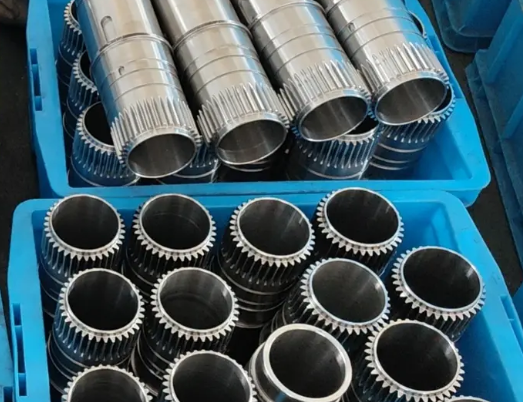
Surface finish and geometric accuracy have direct impact on friction, wear, sealing performance, and noise level. CNC machining processes provide control over roughness, flatness, and roundness within defined tolerances.
Surface Roughness Targets
Piston surfaces, rod surfaces, and sealing areas typically require low roughness values to minimize leakage and wear. Inner cylinder walls for pneumatic and hydraulic actuators are frequently honed to achieve controlled surface texture and geometry.
Geometric Tolerances
Geometric tolerances such as cylindricity, perpendicularity, parallelism, and runout are applied to critical features like bearing seats, screw supports, and sealing bores. Proper application of geometric dimensioning and tolerancing (GD&T) helps ensure that components assemble smoothly and function reliably even with stack-up of small deviations.
Machining Processes for Actuator Components
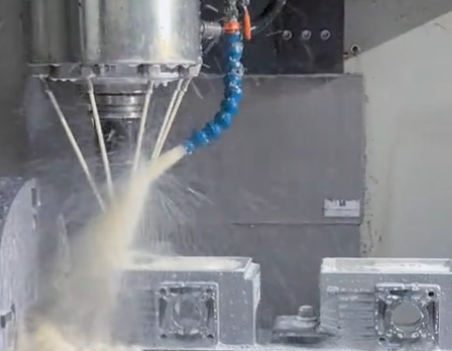
Multiple CNC processes are used in combination to manufacture actuator components from raw bar, plate, casting, or forging stock. Process selection depends on geometry, tolerance, and batch size.
Turning and Boring
CNC turning is used extensively for shafts, rods, pistons, and cylindrical housings. Boring operations produce internal diameters with controlled tolerance and surface finish. Deep-hole drilling and boring are commonly applied for long cylinder barrels and rod passages.
Milling and Drilling
CNC milling produces complex geometries such as mounting flanges, port features, pockets, and flat faces. Drilling, reaming, and tapping operations create threaded ports, alignment pin holes, and patterns for fasteners.
Grinding, Honing, and Lapping
Where very low surface roughness and precise size are required, secondary finishing operations are employed. Grinding is often used for rod surfaces and bearing journals, while honing is applied to internal cylinder surfaces. Lapping may be used for very precise sealing surfaces or mating faces.
Multi-Axis and Turn-Mill Centers
Multi-axis machining centers and turn-mill machines reduce setups by combining operations in one clamping, which improves concentricity and dimensional consistency between related features. This is particularly useful for complex housings and integrated shaft features with cross-holes, keyways, or spline ends.
Design Considerations for CNC Machined Actuator Parts
Design decisions strongly influence machinability, cost, and performance. Detailed attention to critical features during the design phase can reduce the number of secondary operations and improve reliability.
Wall Thickness and Structural Stiffness
Consistent wall thickness helps minimize distortion during machining and heat treatment. In housings and cylinders, adequate stiffness is required to resist pressure-induced deformation and side loads, while avoiding unnecessary weight.
Tool Access and Fixturing
Parts should be designed so that tools can access all required faces with minimal setups. Flat reference surfaces, well-chosen datum features, and symmetric geometry simplify fixturing and measurement, improving repeatability.
Thread Types and Port Interfaces
Thread standards (e.g., metric, UN, NPT, BSPP, BSPT) should be selected based on system requirements and regional norms. For fluid power ports, standardized profiles such as ISO or NFPA patterns enable compatibility with fittings and valves.
Integration of Sealing Features
Seal grooves, O-ring glands, and surface transitions must comply with sealing component specifications. Machined corners, chamfers, and fillets should support reliable assembly of seals and minimize risk of damage during installation.
Performance and Reliability Factors
Proper CNC machining contributes to actuator lifespan, positional accuracy, and load capability. Several performance factors are closely linked to manufacturing quality.
Load Capacity and Fatigue Life
The ability of an actuator to carry axial, radial, and bending loads depends on material strength, cross-section geometry, and surface condition. CNC machining must avoid grooves or sharp transitions that concentrate stresses and reduce fatigue life.
Leakage Control in Fluid-Powered Actuators
For pneumatic and hydraulic systems, leakage occurs at interfaces between machined surfaces and seals, threaded connections, and around rods. Tight control of clearances, finishes, and straightness helps maintain acceptable leakage levels over the service life.
Thermal and Environmental Effects
Temperature variations cause dimensional changes. Choice of material and tolerances must account for operating temperature range, especially in applications with long strokes or precision positioning. Corrosive environments require corrosion-resistant materials or protective coatings on machined parts.
Quality Control and Inspection
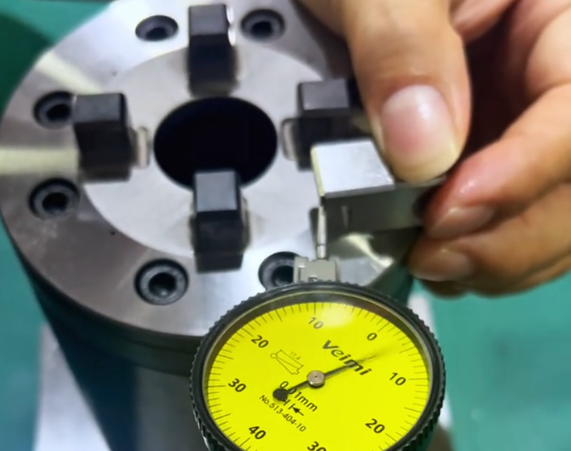
Inspection processes verify whether machined actuator components conform to specifications. Effective quality control contributes directly to reliability and interchangeability of actuator assemblies.
Dimensional Inspection
Typical methods include coordinate measuring machines (CMM), height gauges, micrometers, bore gauges, and surface roughness testers. Sampling plans or 100% inspection may be used depending on component criticality and batch size.
Pressure and Leak Testing
Hydraulic and pneumatic actuator components may be tested for pressure containment and leakage. Test rigs can verify assembly integrity and detect defects in machined surfaces, sealing grooves, or threaded joints.
Documentation and Traceability
Quality records for materials, heat treatment, and machining dimensions support traceability. Documentation helps identify root causes if field failures or deviations occur, enabling adjustments to machining parameters or design features.
Typical Issues in CNC Machining for Actuators
Actuator manufacturers and users often encounter recurrent issues related to machined parts. Addressing these issues systematically reduces downtime, rework, and warranty costs.
Distortion and Dimensional Drift
Long rods, thin-walled cylinders, and complex housings can deform during machining or heat treatment. This may cause bore misalignment, non-cylindricity, or unacceptable runout. Process planning, balanced material removal, and suitable fixturing are important to control distortion.
Surface Defects Affecting Sealing
Scratches, chatter marks, and tool steps on sealing surfaces quickly lead to leakage or accelerated seal wear. Inspection and appropriate finishing operations reduce this risk. Proper tool selection, cutting parameters, and chip evacuation also contribute to clean surfaces.
Thread and Port Incompatibility
Using inconsistent thread types or minor deviations in port geometry can lead to assembly issues, leaks, or cross-threading. Standardization of ports, clear drawings, and verified tooling are needed to ensure compatibility with fittings and mating parts.
Comparison of CNC Machining for Different Actuator Types
Requirements for CNC machining vary with actuator type. Some are dominated by high-pressure constraints, others by positional precision or environmental exposure.
| Actuator Type | Key Machined Features | Primary Requirements |
|---|---|---|
| Electric linear | Screw shafts, nut housings, guide bores | High positioning accuracy, low backlash, precise alignment |
| Electric rotary / servo | Bearing seats, gear interfaces, encoder mounts | Low runout, tight concentricity, stable mounting faces |
| Pneumatic cylinder | Cylinder bore, piston, rod, end caps | Good sealing, low friction, controlled surface finish |
| Hydraulic cylinder | High-pressure barrel, gland, rod | High strength, minimal distortion, reliable sealing under pressure |
Practical Guidelines for Sourcing CNC Machined Actuator Parts
When sourcing machined components for actuators, several practical aspects should be clearly defined to suppliers to ensure consistent quality and performance.
Technical Documentation
Drawings and 3D models should include all necessary dimensions, tolerances, surface roughness, GD&T symbols, material specifications, heat treatment requirements, and coating instructions. Missing or ambiguous information can result in non-conforming parts.
Process Capabilities and Equipment
Suppliers should have equipment suitable for the length, diameter, and complexity of actuator components. Long-bed lathes, deep-hole boring equipment, honing machines, and multi-axis machining centers are often necessary for various actuator parts.
Consistency and Repeatability
For replacement components and serial production, consistency across batches is critical. Process control, tool life management, and calibration of measuring equipment support repeatable dimensional quality.