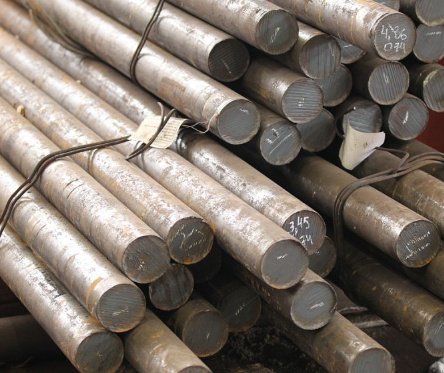
50CrVA and SAE 6150 are closely related chromium–vanadium spring steels widely used for highly stressed components such as automotive leaf springs, coil springs and wear-resistant parts. Their balance of high strength, toughness, fatigue resistance and hardenability makes them a standard choice in many mechanical and automotive designs.
Material Designation, Standards and Equivalents
50CrVA and SAE 6150 belong to the group of chromium–vanadium alloy steels designed mainly for springs and dynamically loaded components. They are not absolutely identical grades but are close enough in composition and performance that they are often discussed together.
| System / Region | Designation | Notes |
|---|---|---|
| China (GB) | 50CrVA | Alloy spring steel, approx. 0.50 % C with Cr and V |
| USA (SAE/AISI) | SAE 6150 | Chromium–vanadium spring steel |
| Europe (EN) | 51CrV4 (e.g. 1.8159) | Commonly used as an equivalent spring steel |
| Germany (DIN) | 51CrV4 | Similar use in automotive and mechanical springs |
| Japan (JIS) | SUP10 (approx.) | Spring steel, Cr–V alloy type |
For critical applications, engineers should always confirm the applicable national or international standard and specify the exact grade, heat treatment condition and mechanical property requirements on drawings and purchase orders.
Chemical Composition
The composition of 50CrVA / SAE 6150 is optimized for high elastic limit, good hardenability and wear resistance while maintaining adequate toughness. Minor vanadium additions refine grain size and improve fatigue properties.
| Element | 50CrVA (typical range) | SAE 6150 (typical range) |
|---|---|---|
| C | 0.47 – 0.55 | 0.48 – 0.53 |
| Si | ≤ 0.35 – 0.80 | 0.15 – 0.35 |
| Mn | 0.50 – 0.80 | 0.70 – 0.90 |
| Cr | 0.80 – 1.10 | 0.80 – 1.10 |
| V | 0.10 – 0.25 | 0.15 – 0.25 |
| P | ≤ 0.025 | ≤ 0.035 |
| S | ≤ 0.025 | ≤ 0.040 |
Minor variations in composition may exist among producers and standards, but the overall alloy design remains focused on the combination of medium carbon, chromium and vanadium for spring performance.
Microstructure and Metallurgical Characteristics
The microstructure of 50CrVA / SAE 6150 after heat treatment is typically tempered martensite with dispersed carbides. The chromium and vanadium contribute to the formation of hard alloy carbides, which enhances wear resistance and maintains high strength at elevated stress levels.
Key metallurgical features include:
- Fine, tempered martensitic matrix after quenching and tempering.
- Carbide dispersion (Cr- and V-rich carbides) that improves secondary hardening, wear resistance and fatigue strength.
- Good through-hardening capability in moderate section sizes due to chromium alloying.
Improper heat treatment can lead to coarse grains, retained austenite or excessive brittle carbides, which degrade toughness and fatigue performance. Controlled austenitizing temperature and time are therefore important.
Mechanical Properties
Mechanical properties of 50CrVA / SAE 6150 depend strongly on heat treatment, section size and testing orientation. The values below represent typical ranges for quenched and tempered conditions used for springs and highly stressed components.
Strength and Hardness
Typical tensile properties for common heat-treated conditions (approximate values):
- Tensile strength Rm: about 900 – 1300 MPa (130 – 190 ksi), depending on hardness and size.
- Yield strength Rp0.2: about 700 – 1100 MPa.
- Elongation A5: commonly 8 – 16 %.
- Reduction of area Z: around 35 – 55 %.
- Brinell hardness: approx. 269 – 331 HB in many structural applications; higher levels (up to ~50 HRC) may be used for specific wear or spring needs.
The optimal hardness level is a compromise between high fatigue strength and sufficient toughness. For leaf and coil springs, hardness is typically controlled around the upper 30s to mid-40s HRC, depending on design and service requirements.
Impact Toughness
50CrVA / SAE 6150 generally exhibits good impact toughness for a spring steel when properly tempered. Charpy V-notch impact values are strongly dependent on tempering temperature. Lower tempering temperatures increase strength and hardness but reduce impact energy, while higher tempering temperatures improve toughness at the expense of some strength.
Typical spring tempering ranges balance these effects to achieve acceptable impact toughness at operating temperatures, especially for automotive components subject to shock loads and vibration.
Fatigue and Endurance Behavior
High fatigue strength is one of the main reasons for selecting 50CrVA / SAE 6150. The combination of fine tempered martensite and alloy carbides provides:
- High endurance limit in bending and torsion.
- Good resistance to cyclic stresses in automotive, rail and mechanical spring components.
- Improved fatigue life under surface treatments like shot peening that introduce compressive residual stress.
Attention to surface finish, decarburization control, and removal of surface defects is essential, as fatigue cracks usually initiate at the surface in cyclically loaded parts.
Physical Properties
Physical properties for 50CrVA / SAE 6150 are similar to other medium-carbon alloy steels.
Typical values at room temperature (approximate):
- Density: about 7.80 – 7.85 g/cm³.
- Modulus of Elasticity (Young’s modulus): about 205 – 210 GPa.
- Poisson’s ratio: about 0.27 – 0.30.
- Thermal conductivity: about 35 – 45 W/(m·K), depending on condition and temperature.
- Coefficient of thermal expansion (20–100 °C): about 11 – 13 × 10⁻⁶ /K.
These values are important for dimensional stability, stress analysis, and finite element simulations of components under thermal and mechanical loads.
Heat Treatment of 50CrVA / SAE 6150
Heat treatment is crucial to achieve the desired combination of strength, ductility and fatigue resistance. The steel is typically delivered in annealed or normalized condition and then heat treated by the component manufacturer according to design requirements.
Soft Annealing
Purpose: improve machinability, relieve internal stresses and refine structure for subsequent processing.
Typical procedure:
- Heating to approximately 750 – 800 °C.
- Holding sufficiently long to equalize temperature.
- Slow cooling in the furnace to around 600 °C and then air cooling.
This cycle produces a spheroidized or fine pearlitic structure with Brinell hardness commonly in the range of about 179 – 217 HB for easier machining.
Normalizing
Normalizing is sometimes used after forging or hot rolling to refine grain size and homogenize structure.
Typical steps:
- Heating to around 850 – 900 °C.
- Soaking for adequate time (depending on section size).
- Cooling in still air.
Normalized structure is typically fine pearlite and ferrite with higher hardness than annealed, providing improved strength for some applications or as a preparation for further hardening.
Hardening (Quenching)
For spring and high-strength components, hardening by quenching is applied.
Representative parameters:
- Austenitizing temperature: approximately 840 – 870 °C (depending on standard, product and section size).
- Holding time: sufficient for complete austenitization without excessive grain growth.
- Quenching media: oil or polymer quenchants are commonly used; water quenching is generally avoided due to the risk of cracking and distortion.
After quenching, the structure is predominantly martensitic and very hard, requiring tempering to adjust properties and relieve stresses.
Tempering
Tempering converts brittle as-quenched martensite into a tougher tempered martensite and adjusts the strength level.
Typical tempering characteristics:
- Tempering temperature range: approximately 400 – 600 °C, selected according to required mechanical properties.
- Higher tempering temperatures increase toughness and reduce hardness and strength.
- Multiple tempering cycles can be used to stabilize properties and reduce residual stresses.
Tempering must avoid the embrittlement temperature ranges specified in applicable standards and literature for chromium–vanadium steels. A tempering curve from material data or trials is recommended to fine-tune hardness and mechanical properties.
Stress Relieving
After machining, forming or welding, stress relieving may be used to reduce residual stresses:
- Typical temperature: about 500 – 650 °C (below the previous tempering temperature to avoid significant changes in mechanical properties).
- Cool slowly (e.g. in furnace) to minimize new stresses.
This is particularly useful for precision components where dimensional stability during service is critical.
Hot Working and Forging
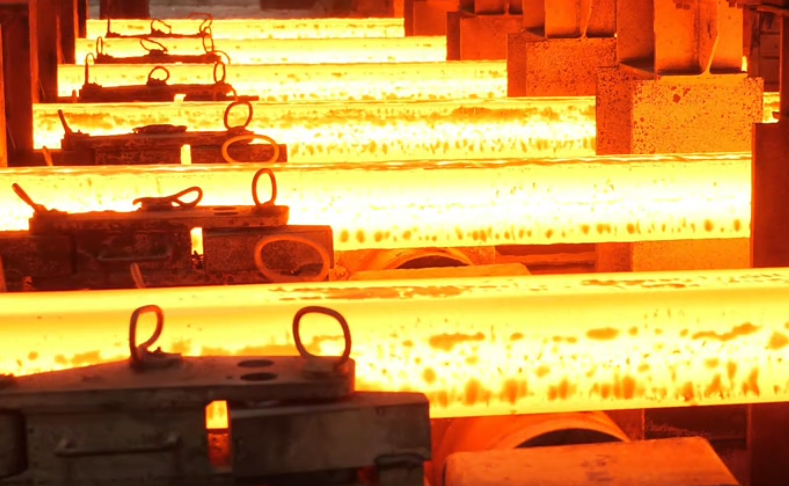
50CrVA / SAE 6150 can be hot worked using common forging and hot rolling practices. Correct temperature control is essential to avoid defects such as coarse grains or cracking.
Typical forging guidelines:
- Forging temperature start: approximately 1150 – 1180 °C.
- Forging temperature end: not below about 850 – 900 °C to prevent cracking and ensure good plasticity.
- After forging, cooling in still air; for large sections, controlled cooling may be necessary to avoid excessive hardness gradients.
Post-forging heat treatment (normalizing or annealing) is recommended to refine microstructure and prepare the material for further processing or final heat treatment.
Cold Working and Forming
Due to its medium carbon content and high strength after hardening, cold workability of 50CrVA / SAE 6150 is limited compared with low-carbon steels. Cold forming operations are therefore usually performed in the annealed or normalized state.
Considerations for cold forming:
- Prefer annealed condition for bending, coiling or stamping to reduce forming forces and risk of cracking.
- For spring manufacturing, coiling may be performed either in the annealed state followed by heat treatment, or in a hardened and tempered state with limited deformation, depending on the process route.
- Severe cold deformation requires intermediate stress relief or spheroidizing annealing to maintain ductility.
Large residual stresses from intensive cold working should be relieved by stress-relief heat treatment to avoid distortion during subsequent machining or service.
Machinability of 50CrVA / SAE 6150
Machinability is an important consideration for users who produce complex, high-precision parts. 50CrVA / SAE 6150 has moderate machinability, and cutting performance is highly dependent on heat treatment state.
Machinability in Different Conditions
In the annealed state (around 180–220 HB), machinability is reasonable and typical operations such as turning, milling, drilling and tapping can be performed with standard tooling and cutting parameters for alloy steels.
In hardened and tempered states with higher hardness (e.g. > 30 HRC), machinability decreases. In such cases:
- Use rigid machine setups and stable fixturing.
- Prefer carbide or coated carbide tools for turning and milling.
- Apply suitable cutting fluids for heat control and surface quality.
High hardness ranges, especially above ~45 HRC, may require specialized tooling such as CBN inserts for precision finishing.
Typical Machining Guidelines
While exact cutting parameters must be optimized for each shop and machine, several practical guidelines are common:
- Use lower cutting speeds and higher feed per tooth than for low-carbon steels, particularly in hardened conditions.
- Provide adequate chip evacuation and coolant flow in drilling to prevent tool breakage and overheating.
- Avoid heavy interrupted cuts in high hardness material to reduce risk of chipping of carbide edges.
- Perform roughing in the annealed state whenever possible, reserving hardened machining for finishing only.
Because the material can exhibit work hardening near the surface under improper cutting conditions, consistent tool geometry and sharp cutting edges are important to maintain dimensional accuracy and surface integrity.
Pain Points in Machining
Typical difficulties encountered with 50CrVA / SAE 6150 include:
- Rapid tool wear and edge chipping at high hardness, especially in interrupted cuts.
- Sensitivity to heat generation leading to dimensional drift and surface hardening if coolant or feed rates are inadequate.
- Need for strict control of residual stresses to prevent distortion after final machining and during service.
Process planning that combines suitable heat treatment stages and machining sequences helps to minimize these complications.
Weldability
Welding of 50CrVA / SAE 6150 is possible but not straightforward due to the medium carbon content and high hardenability. Without precautions, welding can lead to hard and brittle heat-affected zones (HAZ), cracking and loss of mechanical properties.
General considerations:
- Preheating is typically required; temperatures in the range of about 150 – 300 °C are common, depending on section size and restraint.
- Post-weld heat treatment is often recommended to restore toughness and relieve residual stresses, for instance tempering or stress relieving.
- Low-hydrogen welding processes and consumables should be used to reduce risk of hydrogen-induced cracking.
For critical components such as highly stressed springs, design practice often aims to avoid welds altogether. If welding is unavoidable, it should be qualified via appropriate weld procedure qualification records and destructive testing.
Corrosion Resistance and Surface Protection
50CrVA / SAE 6150 is not a stainless steel. Corrosion resistance is comparable to other medium-carbon alloy steels and is generally insufficient for unprotected service in corrosive or humid environments.
Common protection methods include:
- Painting or powder coating for large spring and structural components.
- Phosphate coating, oiling or other thin-film protective treatments for automotive springs and small parts.
- Electroplating (e.g. Zn or Zn–Ni) or mechanical plating for enhanced corrosion resistance where design permits.
- Use of protective greases or lubricants during storage and operation.
For long-term outdoor or aggressive environments, periodic inspection and maintenance of coatings and seals is recommended to maintain corrosion protection.
Typical Applications of 50CrVA / SAE 6150
50CrVA / SAE 6150 is primarily used where high fatigue resistance and wear resistance are required along with significant elastic deformation capability. Representative applications include:
Automotive and Transportation Components
- Leaf springs and parabolic springs for trucks, buses and commercial vehicles.
- Coil springs for suspension systems and stabilizers.
- Torsion bars, anti-roll bars and other elastic suspension elements.
- Clutch and brake springs and related components.
The grade’s combination of strength and toughness under repeated load cycles is particularly advantageous in these applications.
Industrial Machinery and Tools
- Heavy-duty coil springs for presses, forming equipment and industrial machinery.
- High-load washers, disc springs and energy storage elements.
- Certain knives, blades, chisels and hand tools requiring wear resistance and resilience.
- Gears, shafts and axles where increased strength and wear resistance are needed and surface hardening methods are applied.
For these uses, 50CrVA / SAE 6150 provides a good compromise between mechanical performance and cost compared with higher-alloy steels.
Other Mechanical and Structural Uses
- Railway components such as springs and associated hardware.
- Elastic couplings and flexible connectors in power transmission systems.
- High-stress fasteners, bolts and pins where both strength and toughness are required.
Selection is usually based on required mechanical properties, component size, operating environment and cost considerations.
Advantages and Limitations
The suitability of 50CrVA / SAE 6150 for a specific design depends on a balance of benefits and constraints.
Key Advantages
- High tensile and yield strength with good fatigue performance, especially for springs and cyclically loaded parts.
- Good hardenability, allowing through-hardening in moderate section sizes.
- Improved wear resistance due to chromium and vanadium carbides.
- Reasonable toughness when properly tempered, enabling use in shock-loaded applications.
- Well-established industrial experience, standards and supply chains for automotive and machinery sectors.
Limitations and Considerations
- Limited intrinsic corrosion resistance; protective coatings or controlled environments are needed for many applications.
- Moderate weldability with risk of cracking unless proper preheating and post-weld heat treatment are applied.
- Machinability decreases rapidly with higher hardness; process planning must consider machinability vs. strength requirements.
- Careful control of heat treatment is necessary to avoid brittleness, decarburization or excessive distortion.
In design and material selection, these limitations should be evaluated alongside mechanical performance requirements and cost targets.
Guidelines for Material Selection and Specification
When specifying 50CrVA / SAE 6150 for a component, it is important to provide clear technical requirements so that material suppliers and heat treatment shops can meet the design intent.
Typical specification elements include:
- Grade designation according to recognized standards (e.g. 50CrVA per GB, SAE 6150, EN 51CrV4).
- Product form: bar, plate, strip, wire, forgings, etc.
- Delivery condition: annealed, normalized, or quenched and tempered to a defined hardness range.
- Required mechanical properties: tensile strength, yield strength, elongation, impact values, hardness, and sometimes fatigue strength or proof loads.
- Heat treatment details if controlled by the purchaser: austenitizing temperature, quench medium, tempering temperature and time.
- Quality requirements: maximum permitted decarburization depth, cleanliness levels, nondestructive testing (if required), dimensional tolerances and surface finish.
- Additional requirements such as surface protection (phosphate coating, painting, plating) or shot peening for springs.
Clear communication of these parameters in technical specifications, purchase orders and drawings reduces the risk of mismatched properties or performance in service.
Storage, Handling and Quality Control
Proper storage and handling support the performance of 50CrVA / SAE 6150 components during manufacturing and service life.
Recommendations include:
- Store in dry, well-ventilated areas to minimize corrosion before coating or assembly.
- Use protective covers or oils for long-term storage of semi-finished products and machined parts.
- Avoid mechanical damage such as dents or gouges on spring surfaces, as these can become fatigue crack initiation sites.
- Apply quality control checks: hardness testing, tensile testing, microstructural examination and dimensional inspection according to design requirements and relevant standards.
For high-volume or safety-critical components, process capability studies and statistical quality control are often used to ensure consistent performance.

Conclusion
50CrVA / SAE 6150 is a widely used chromium–vanadium alloy spring steel that offers high strength, good fatigue resistance and adequate toughness when correctly heat treated and processed. Its established performance in automotive suspension systems, industrial machinery and other high-load applications makes it a reliable choice for engineers seeking a balance of performance, availability and cost.
Successful use of this material depends on coordinated control of composition, heat treatment, machining, surface condition and protective measures. With appropriate specifications and process control, 50CrVA / SAE 6150 can provide long, reliable service in demanding mechanical environments.
FAQ
Are 50CrVA and SAE 6150 the same steel?
50CrVA and SAE 6150 are not identical by standard, but they are considered equivalent or closely comparable chrome vanadium spring steels. They have similar chemical composition, mechanical properties, and heat treatment behavior, and are often interchangeable in engineering applications with proper specification review.
What are the typical applications of 50CrVA / SAE 6150 steel?
50CrVA / SAE 6150 steel is commonly used for springs, automotive suspension components, shafts, gears, and high-stress mechanical parts that require high strength, good toughness, and excellent fatigue resistance.
What is the machinability of 50CrVA / SAE 6150 compared to carbon steel?
The machinability of 50CrVA / SAE 6150 is lower than plain carbon steels such as AISI 1045, but comparable to other alloy spring steels. Machinability decreases significantly after quenching and tempering, so most machining is performed before final heat treatment.
Is 50CrVA / SAE 6150 corrosion resistant?
No, 50CrVA / SAE 6150 is not corrosion resistant. Protective coatings, surface treatments, or proper lubrication are recommended if the parts are used in corrosive environments.