A vacuum manifold block is a rigid distribution body used to route vacuum from one or more sources to multiple outlets in a controlled, leak‑tight manner. It is widely used in automation, process equipment, semiconductor tooling, laboratory systems, packaging lines and custom vacuum fixtures. A well‑designed manifold block minimizes leaks, stabilizes vacuum levels, simplifies plumbing and provides a compact, serviceable interface between pumps, valves, sensors and end‑effectors.
Fundamental Functions of a Vacuum Manifold Block
A vacuum manifold block performs several core functions inside a vacuum system, acting as both a mechanical component and a flow control element.
- Distributes vacuum from one source to multiple loads
- Combines multiple sources or zones into a common header
- Provides mounting and porting interface for valves and sensors
- Reduces external tubing complexity and potential leak points
In automated systems, the block is frequently the central node where vacuum pumps, ejectors, filters, regulators, gauges, switches and field connections converge. Its internal passages are engineered to maintain adequate conductance and minimize pressure losses, while the external faces offer standardized ports and mounting patterns.
Construction and Materials
The construction and material selection of a vacuum manifold block directly affects its pressure capability, leak tightness, chemical compatibility and long‑term stability.
Base Materials
Common base materials include aluminum, stainless steel and engineered plastics. Material choice is usually driven by operating pressure range, cleanliness requirements, media compatibility and weight constraints.
| Material | Typical Applications | Key Characteristics |
|---|---|---|
| Aluminum (e.g., 6061‑T6) | General automation, packaging, vacuum fixtures | Lightweight, good machinability, adequate strength for rough and medium vacuum, anodizing possible |
| Stainless Steel (e.g., 304, 316) | High cleanliness, corrosive media, process and lab vacuum | High corrosion resistance, good vacuum performance, suitable for higher temperature and aggressive environments |
| Brass | General purpose, low to medium vacuum distribution | Good machinability, decent corrosion resistance, commonly used for port fittings |
| Engineering Plastics (e.g., POM, PTFE) | Light‑duty systems, chemically aggressive gases, weight‑sensitive tools | Low weight, specific chemical resistance, more limited mechanical strength and temperature range |
Surface Treatments
Surface treatments aim to improve corrosion resistance, cleanliness, outgassing performance or wear resistance:
- Anodized aluminum for surface hardness and corrosion protection
- Electropolished stainless steel for reduced surface roughness and improved cleanability
- Nickel plating for enhanced corrosion resistance and barrier properties on ferrous metals
In higher‑grade vacuum or clean applications, internal surfaces are often specified with controlled roughness and low contamination potential to reduce outgassing and facilitate cleaning.
Sealing and O‑Ring Materials
Vacuum manifold blocks rely on static and sometimes dynamic seals between the block and attached components. O‑ring grooves or gasket faces are machined directly into the block. Seal materials are chosen for permeability, compression set resistance, temperature capability and media compatibility. Typical options include NBR, FKM, EPDM and perfluoroelastomers. In high vacuum applications, metal gaskets or specialized low‑outgassing elastomers are preferred. Seal groove geometry is usually specified to industry standards to ensure repeatable compression and leak performance.
Internal Flow Paths and Porting Configurations
Internal flow configuration determines how vacuum is distributed and how efficiently gas can be evacuated from the connected volume. Manifold blocks can be simple linear headers or complex multi‑zone distribution bodies.
Common Flow Layouts
Typical layout styles include:
Single inlet, multiple outlet header: A central bore runs along the block length, with multiple outlet ports branching off. This is the most common configuration in small automation manifolds and vacuum clamping fixtures.
Multiple zone channels: Separate internal channels provide independently controlled vacuum zones, often paired with individual valves. This is used where different tooling areas require separate vacuum levels or on/off control.
Combined or cross‑connected channels: Used where redundancy or balancing between multiple pumps or ejectors is desired. Check valves may be integrated externally to prevent backflow between sources.
Port Types and Thread Standards
Ports in a vacuum manifold block are commonly threaded or flanged. Thread types are selected to match regional standards and equipment interfaces. Common standards include NPT, BSPP, BSPT and metric threads. For higher performance or clean vacuum, specialized vacuum flanges and face seals may be used in place of pipe threads to reduce leak risk and particle generation.
Channel Dimensions and Conductance
Internal channel diameter and length determine conductance, which defines how easily gas can flow under vacuum. Undersized passages can cause pressure drop and slow evacuation times, particularly in medium or high vacuum conditions. Design practice typically balances compact manifold size against acceptable pressure loss, taking into account:
- Maximum expected flow rate (standard liters per minute or cubic meters per hour)
- Operating pressure range and pump characteristics
- Permissible pressure drop between source and furthest outlet
Transitions, sharp corners, sudden diameter changes and unnecessary restrictions are minimized to maintain laminar flow where possible and reduce turbulence‑related losses.
Mounting Interfaces and Manifold Geometry
Mechanical geometry and mounting interfaces are tailored to how the manifold integrates into the machine or system. Compact, modular blocks reduce footprint and simplify assembly.
Mounting Features
Common mounting features include through‑holes, counterbored holes, tapped holes and alignment dowel holes. In many automation designs, the manifold serves as both a flow body and a structural element holding valves, fittings and sensors in fixed positions. Mounting patterns may match specific valve families or standardized industrial footprints so that components can be installed directly without intermediate brackets.
Orientation and Access
Orientation of the ports and faces is determined by serviceability, hose routing and panel layout. Ports may be grouped on one or more faces (top, side, end) to separate source connections, instrument connections and workpiece or tool connections. Service access for replacing valves, filters or sensors is considered, ensuring that critical components are reachable without dismantling the entire vacuum circuit.
Sealing Interfaces and Leak Management
Leak control is a primary requirement in vacuum systems. Manifold blocks are designed to limit both internal bypass leakage and external leakage to atmosphere.
Static Sealing Surfaces
Static joints are typically sealed via O‑rings in grooves, gasket faces, or metal‑to‑metal contact supported by soft gaskets or sealants. Surface flatness and surface roughness are tightly controlled, especially for larger sealing faces. Bolt patterns and torque specifications are selected to produce uniform sealing pressure without distorting the block.
Threaded Connections and Fittings
Threaded port connections are potential sources of leaks and are normally sealed with compatible thread sealant, PTFE tape or bonded seals depending on the thread type. For clean or higher vacuum systems, face‑seal fittings or compression fittings with metal ferrules may be used instead of tapered threads to reduce outgassing and ensure consistent long‑term sealing.
Leak Rate Considerations
Acceptable leak rate depends on system requirements. Rough vacuum manifolds used in packaging or handling applications can tolerate higher leakage than high vacuum manifolds used in analytical or process equipment. Manufacturing processes such as precision machining, deburring, cleaning and careful handling of sealing surfaces are critical to achieving the specified leak rate. Post‑assembly testing with vacuum decay or helium leak detection is often used to validate performance.
Vacuum Pressure Ranges and Performance Parameters
Manifold blocks must operate effectively over the pressure range of the system. Common industrial vacuum levels span from rough vacuum up to high vacuum for specialized equipment. Key performance parameters include allowable pressure range, maximum differential pressure, leak rate, flow capacity and allowable temperature range.
| Vacuum Range | Approximate Pressure | Typical Manifold Use |
|---|---|---|
| Rough Vacuum | ~1013 mbar down to 1 mbar | Pick‑and‑place, packaging, woodworking, general automation |
| Medium Vacuum | 1 mbar to 10-3 mbar | Process equipment, degassing, some laboratory systems |
| High Vacuum | 10-3 mbar to 10-7 mbar | Semiconductor tools, analytical equipment, specialized research |
Most standard industrial manifold blocks are designed for rough to medium vacuum. High vacuum operation typically requires more stringent material selection, surface finish control, reduced elastomer usage and specialized connection interfaces.
Sizing and Selection Criteria
Proper sizing and selection are critical to achieve stable vacuum levels and adequate evacuation speed. Oversimplified choices can lead to unstable grip in handling applications, slow response in process steps, or unnecessary pump oversizing.
Flow and Port Sizing
Selection starts with determining total required flow and the number of outlets. Relevant factors include:
- Maximum flow demand at each outlet under worst‑case leakage and process conditions
- Simultaneous operation of multiple outlets or zones
- Required response time for reaching target vacuum level
Channel diameters and port sizes are then chosen to maintain sufficient conductance. In many applications, port sizes are aligned with downstream components (suction cups, clamps, fixtures) and upstream devices (pumps, ejectors, regulators). Oversizing channels reduces pressure loss but increases block size and weight.
Material and Environmental Conditions
Environmental and process conditions directly influence material and seal selection:
- Exposure to oils, solvents, cleaning agents or process gases
- Ambient and process temperature range
- Outdoor versus indoor installation, humidity and potential condensation
For aggressive media or elevated temperatures, stainless steel blocks with high‑temperature seals are frequently used. In weight‑sensitive end‑of‑arm tooling, aluminum blocks with compact channels are common.
Number of Stations and Modularity
Vacuum manifold blocks are often offered as multi‑station designs where several identical outlet ports are arranged along the block. When system layouts change frequently, modular manifolds composed of shorter segments or stackable bodies allow reconfiguration without complete redesign. The number of stations is defined by the number of outlets and integrated functional elements such as valves or flow restrictors per outlet.
Integration with Pumps, Valves and Instrumentation
Integration of the vacuum manifold block with pumps, control devices and measurement instruments determines the overall system architecture and controllability.
Connection to Vacuum Sources
One or more ports are dedicated to connection with the vacuum source, which may be an electric rotary vane pump, dry pump, liquid ring pump or compressed‑air‑driven ejector. For centralized systems, a main header block distributes vacuum to various machine zones. For localized systems, small ejectors may mount directly to the manifold block to minimize response delay and reduce hoses on moving axes.
Integration of Valves and Regulators
Directional control valves, on/off valves, proportional valves and vacuum regulators can be mounted to the manifold via standard patterns. This allows zone‑specific activation or control of vacuum level. Certain blocks include internal passages that route pilot signals, vacuum supply and vent paths between the valves and outlets without external tubing. Manifold‑mounted regulators can stabilize vacuum level at the tools even when supply fluctuates or multiple tools are operating simultaneously.
Vacuum Measurement and Monitoring
Gauge ports, pressure transmitters, switches and sensors connect to dedicated measurement points on the manifold. Strategically placed measurement ports reflect the vacuum level actually seen by the load rather than just at the pump outlet. Integrated monitoring helps detect leaks, clogged filters and unexpected load changes. Electrical or pneumatic signal interfaces from these devices are typically routed externally, while the pressure interface is via threaded or flanged connections on the block.
Application Examples
Vacuum manifold blocks are applied across a wide range of industries. Although geometries and specifications differ, the underlying principles of distribution and control remain similar.
Automation and Robotics
In pick‑and‑place systems, a manifold feeds multiple suction cups or grippers mounted on a common end‑of‑arm tool. The block may include isolation valves for individual cups, a common vacuum gauge port and one or two main supply ports connected to ejectors or pumps mounted on the robot arm or nearby structure. Compact design and low mass are important to avoid affecting robot dynamics.
Vacuum Clamping and Workholding
In machining, woodworking and stone processing, vacuum manifold blocks distribute vacuum to multiple clamping zones on a fixture. Channels are designed to support quick evacuation of cavities and reliable holding force, even when certain zones are unused or partially leaking. Manifolds may be integrated directly into the fixture body or provided as separate blocks connected to modular vacuum cups and rails.
Laboratory and Process Equipment
Laboratories often use manifold blocks on vacuum racks to supply multiple instruments or reaction vessels from one pump. Process equipment for degassing, drying or thin‑film processes uses manifolds to route vacuum from one or more pumps to chambers, traps and measurement devices with controlled isolation. Material compatibility and cleanliness are often prioritized over weight, with stainless steel and clean internal finishes preferred.
Issues and Practical Considerations
When specifying or using vacuum manifold blocks, certain practical issues must be considered to avoid performance degradation or maintenance problems.
Leakage and Assembly Quality
Each additional fitting, adapter or plug introduces a potential leak point. Overuse of adapters, mixed thread standards or poor assembly practices can compromise vacuum performance. Selecting a manifold with appropriate built‑in port types and minimizing external connections reduces these risks. Controlled torque, specified sealants and correct O‑ring handling are important during installation.
Contamination and Clogging
Dust, chips, liquids and vapors drawn into the vacuum system can accumulate inside the manifold channels and at outlet ports. Over time this can reduce effective cross‑section, increase pressure drop and cause uneven vacuum distribution. Inline filters or strainers placed near the manifold inlets or outlets, as well as drain points where condensate may collect, help maintain reliable operation. In some applications, the manifold is designed with removable plugs or covers to allow periodic inspection and cleaning.
Uneven Vacuum Distribution
If the manifold channels are undersized or excessively long, distant outlets may experience lower vacuum levels than those close to the source, particularly under high flow demand. This can lead to inconsistent gripping force or variable processing conditions across tools. Careful sizing and positioning of the source port, use of larger channel diameters and balancing orifices can mitigate these issues. Where high uniformity is required, designers often simulate or calculate pressure drop across the manifold at expected operating points.
Manufacturing and Quality Control
Vacuum manifold block performance is strongly influenced by manufacturing quality and inspection methods.
Machining and Tolerances
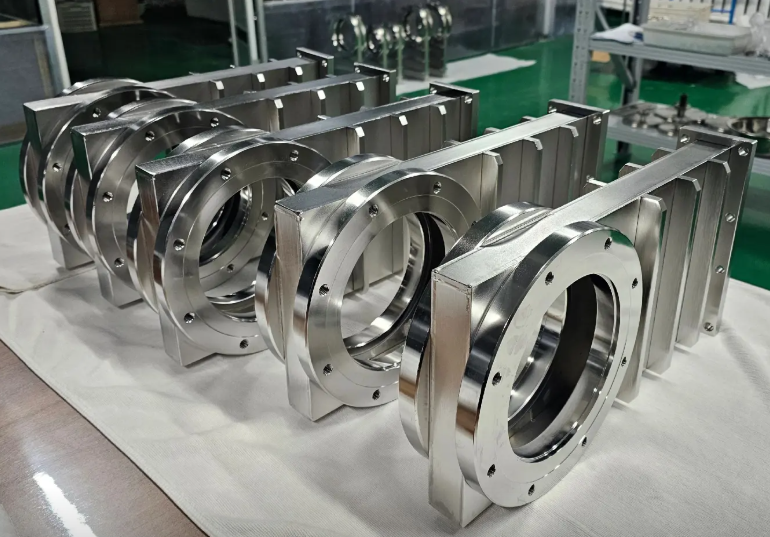
Blocks are typically produced by CNC machining from bar stock or plate. Accurate drilling, milling and tapping ensure that channels intersect correctly and port faces are square and flat. Tolerances for sealing surfaces and alignment features must be sufficient to maintain reliable seal compression and component fit. Burr removal, cleaning of internal passages and removal of entrapped chips are essential to prevent contamination and flow restriction.
Cleaning and Degreasing
Before assembly, manifold blocks are often cleaned to remove oils, particles and machining residues. Cleaning processes may include aqueous washing, ultrasonic cleaning, solvent rinsing or other methods compatible with the material. For higher vacuum or clean applications, stricter cleaning and packaging protocols are used to minimize outgassing and particle generation.
Leak and Pressure Testing
Finished manifolds are commonly tested with pressure or vacuum methods. Vacuum decay testing, pressure hold testing or helium leak detection may be used depending on required sensitivity. Documentation of leak test results, material traceability and dimensional inspection can be important for regulated industries or critical equipment.
FAQ About Vacuum Manifold Blocks
What is a vacuum manifold block?
A vacuum manifold block is a machined component used to distribute vacuum from a single source to multiple ports, allowing efficient and stable vacuum control in industrial systems.
What materials are commonly used for vacuum manifold blocks?
Vacuum manifold blocks are typically made from aluminum, stainless steel, or engineering plastics. Aluminum is the most common choice due to its light weight, corrosion resistance, and ease of machining.
What thread standards are available for vacuum ports?
Common thread standards include NPT, BSPP, BSPT, and metric threads. Custom thread types are also available upon request.
Are vacuum manifold blocks suitable for high-vacuum applications?
Yes, when properly designed and sealed, vacuum manifold blocks can be used in both low- and high-vacuum applications. Material selection and surface finish are critical for high-vacuum performance.
What machining process is used to manufacture vacuum manifold blocks?
Vacuum manifold blocks are usually manufactured using CNC milling and drilling to ensure high precision, smooth internal passages, and consistent quality.