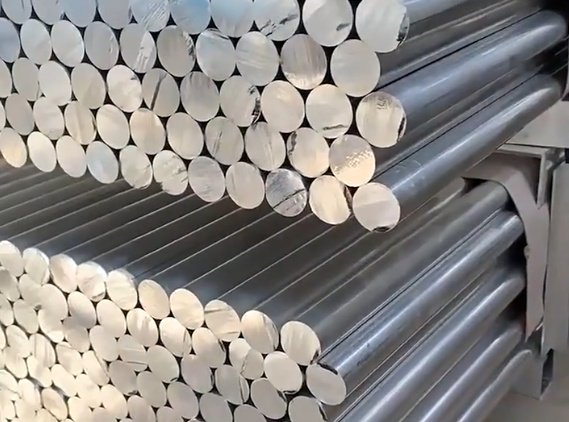
Material selection is one of the most influential decisions in CNC machining. It determines not only the mechanical performance of the final part but also the cost per piece, the total machining time, tooling requirements, surface finish quality, and delivery lead time. Understanding how different material properties translate into practical machining consequences allows engineers and buyers to optimize both price and schedule without compromising functional requirements.
Key Ways Material Choice Impacts CNC Cost and Lead Time
Material affects CNC machining economics and timing through several technical factors:
- Machinability and cutting speeds
- Tool wear and tooling cost
- Required machine power and rigidity
- Chip formation and evacuation
- Dimensional stability and distortion
- Raw stock price and availability
- Pre-processing and post-processing operations
Each factor combines to determine total cycle time per part, setup complexity, scrap risk, and overall throughput, which directly drive cost and lead time.
Machinability and Cutting Parameters
Machinability describes how easily a material can be cut to achieve acceptable tool life, surface finish, and dimensional accuracy. It is quantified in practice through achievable cutting speeds, feed rates, and depth of cut without excessive wear or chatter.
Machinability and Cycle Time
Higher machinability allows for higher cutting speeds and feeds, reducing the time the tool spends removing material. Materials with poor machinability require conservative parameters, dramatically increasing cycle time per part, especially for high-volume production or deep material removal.
Typical approximate relationships:
- Free-machining brass can allow cutting speeds several times higher than carbon steel.
- Aluminum alloys often enable higher feed rates than stainless steel or titanium.
- Hardened tool steels and superalloys need significantly reduced speeds, increasing machining time.
When a design requires large pockets, deep cavities, or extensive 3D surfacing, these speed differences translate into large variations in machine-hours and therefore cost and lead time.
Common Material Machinability Ranges
Practical machinability trends for CNC milling and turning (relative, not absolute values):
| Material Group | Relative Machinability | Typical Cutting Speed Range (m/min, milling) | Notes |
|---|---|---|---|
| Free-cutting brass (e.g., C360) | Very high | 150–300+ | Short chips, excellent for high-volume turning |
| Aluminum alloys (e.g., 6061, 6082, 7075) | High | 200–600 | High speeds; good for prototypes and production |
| Mild/carbon steels (e.g., 1018, 1045) | Medium | 80–200 | Balanced cost and strength; moderate speeds |
| Stainless steels (e.g., 304, 316) | Low–medium | 50–150 | Work hardening can increase tool wear |
| Tool steels (heat-treated) | Low | 30–120 | Requires rigid setups, often carbide tooling |
| Titanium alloys (e.g., Ti-6Al-4V) | Low | 30–80 | Poor thermal conductivity, high cutting forces |
| Engineering plastics (e.g., POM, Nylon, PEEK) | Medium–high | 150–400 | Limited by deformation and heat buildup, not tool wear |
These ranges illustrate why two parts with identical geometry can differ widely in machining cost and lead time when made from different materials.
Tool Wear, Tooling Cost, and Setup Complexity
The rate of tool wear depends strongly on hardness, abrasiveness, microstructure, and thermal properties of the material. Rapid tool wear increases tooling cost, setup frequency, and risk of downtime, all of which influence both cost and lead time.
Hardness and Abrasiveness
Harder and more abrasive materials significantly reduce tool life. Examples:
- Hardened tool steels, nickel-based alloys, and some stainless steels require high-quality carbide or coated tools and generate more heat at the cutting edge.
- Composite materials or filled plastics (glass-filled, carbon-filled) are abrasive, wearing tools faster than unfilled polymers.
Shorter tool life leads to:
Increased tooling cost per part due to more frequent tool replacements, and more frequent tool changes that extend machine setup time and reduce effective spindle utilization. In high-precision work, worn tools may cause out-of-tolerance dimensions and scrap, leading to rework and schedule shifts.
Tooling Strategy and Number of Tools
Some materials require a broader toolset:
- Roughing tools optimized for bulk material removal.
- Finishing tools that operate at different speeds and feeds for improved surface finish.
- Specialized drills, reamers, or thread mills suited to specific alloys or plastics.
Materials that demand multiple tool types increase setup complexity and programming time, which adds indirect cost and may lengthen lead time, especially for short production runs and prototypes where setup overhead is a high proportion of total effort.
Machine Requirements and Power Consumption
Material selection influences the type of CNC machine, spindle power, rigidity requirements, and overall energy usage. High-strength metals and difficult-to-cut alloys generally need machines with higher torque, rigidity, and stability to maintain tolerances and prevent chatter.
Machine Capability and Availability
Not all shops have equipment suited for every material. For instance:
- Cutting titanium or hardened steel may require high-torque spindles, robust fixturing, and advanced coolant systems.
- Light-duty machines are adequate for soft aluminum or plastics but may struggle with heavy cuts in tough alloys.
If a part’s specified material requires specialized machines that are heavily utilized or less common, queue times can increase. This directly affects lead time, especially in busy periods where more common aluminum or mild steel work can be scheduled faster.
Energy and Wear on Machines
Materials needing higher cutting forces increase machine load and energy consumption. While energy cost per part is usually a smaller component than labor and overhead, the accelerated wear on machine components (spindles, ball screws, bearings) is factored into a shop’s cost model. Tougher materials often carry higher hourly machining rates to recover these costs, which flows into the price offered to customers.
Chip Formation, Coolant, and Surface Finish
Chip formation behavior and thermal properties are crucial for machining efficiency and part quality. These characteristics influence tool selection, coolant strategy, and achievable surface finish, all of which can alter machining time and scrap rates.
Chip Control and Evacuation
Different materials generate chips with distinct shapes and tendencies:
- Ductile materials like pure aluminum or some plastics may form long, continuous chips that wrap around tools, requiring chip-breaker geometry or specific tool paths.
- Brittle materials or free-machining metals produce short, easily evacuated chips, supporting higher-volume automated production.
If chips are difficult to manage, machinists may need slower feeds, more retracts, or manual intervention to clear chips. This reduces automation potential and lengthens machining cycles, especially in deep pockets or small cavities.
Coolant Requirements and Heat Management
Materials with poor thermal conductivity (e.g., titanium, some stainless steels) concentrate heat at the cutting edge. Effective cooling is essential to protect tools and maintain tolerances. This can require:
- High-pressure coolant systems.
- Special coolant chemistries and filtration.
- Conservative cutting parameters, further slowing the process.
By contrast, many aluminum alloys dissipate heat efficiently, allowing higher speeds with simpler coolant setups, reducing both cycle time and complexity.
Dimensional Stability, Tolerances, and Distortion
Material behavior under machining loads and temperature variations strongly influences dimensional accuracy, tolerance capability, and rework risk. This directly affects how many operations are required, how much inspection is needed, and whether parts need corrective machining.
Elasticity and Residual Stress
Materials with higher elasticity (such as many plastics) tend to deflect under cutting forces, making tight tolerances more difficult. Workpiece deflection can cause tapered walls, inconsistent diameters, and poor flatness.
Metals with significant residual stresses, especially certain aluminum or steel stock forms, may warp when large volumes of material are removed. The machining sequence, depth of cut, and fixturing strategy must be designed to minimize distortion. This may require:
- Multiple semi-finishing passes.
- Stress-relief heat treatment between roughing and finishing.
- Additional setups to re-clamp parts for final finishing.
Each additional operation lengthens lead time and increases cost due to extra machine time, handling, and inspection.
Thermal Expansion and Environmental Sensitivity
Materials with high thermal expansion coefficients (e.g., many plastics) change dimensions with temperature. During machining, heat from cutting can temporarily expand the workpiece, complicating dimensional control. After cooling, parts may shrink, causing deviations from target dimensions.
In practical terms, achieving tight tolerances with such materials may require:
- Lower cutting speeds to reduce heat generation.
- Dwell time for parts to stabilize before final finishing cuts.
- Controlled shop temperature during inspection and machining.
These constraints extend machining time and may necessitate more iterations of cutting and measuring, impacting lead time and CNC machining cost, particularly for precision components.
Raw Material Cost, Forms, and Availability
Beyond machining behavior, the base price and availability of raw material are core cost and lead time drivers. Raw material choices also impact waste volume and how efficiently parts can be nested or cut from stock.
Material Price per Unit Weight and Volume
Material cost per kilogram or per unit volume varies widely:
- Common aluminum alloys and low-carbon steels are generally lower cost per kg.
- Stainless steels, high-performance alloys, and titanium are significantly more expensive per kg.
- High-performance engineering plastics (such as PEEK or PPS) often cost far more than commodity plastics and many metals.
Because CNC machining is a subtractive process, material utilization (ratio of final part volume to starting stock volume) is a major factor. Parts with extensive pockets or thin walls start from larger, heavier blocks, increasing both raw material cost and material removal time. For expensive alloys, this effect can be substantial.
Stock Forms and Procurement Lead Time
Material is usually procured as plate, bar, billet, or profile. Availability and standard sizes affect:
- How quickly raw stock can be obtained.
- How much pre-cutting or sawing is needed.
- How much unused material remains as scrap.
Widely used materials in standard dimensions are typically stocked by suppliers and sometimes by machine shops themselves, enabling short lead times. Specialized grades, unusual thicknesses, or non-standard bar dimensions may require special orders and long procurement times, adding days or weeks to project schedules.
Influence of Material on Part Geometry and Fixturing
Material properties affect how complex geometries are machined and how parts are held during machining. Poor choices can result in multiple setups, complex fixtures, or design adjustments that increase cost and time.
Wall Thickness, Feature Size, and Material Stiffness
Less rigid materials, including soft metals and plastics, impose limits on wall thickness and unsupported feature length. Thin walls in such materials may vibrate or deflect, leading to poor surface finish, dimensional errors, or breakage.
To maintain dimensional accuracy, machinists may need to:
- Increase wall thickness beyond minimums acceptable in stiffer materials.
- Use support features or temporary tabs that are later removed.
- Apply reduced feeds and depths of cut, lengthening machining time.
If the initial design does not account for these material constraints, additional iterations between design and manufacturing may be required, extending overall lead time.
Fixturing Strategies and Clamping Forces
Material strength and surface hardness determine how much clamping force can be applied without deforming the part. Soft materials such as certain plastics or soft alloys can be marked or distorted by aggressive clamping, while harder metals tolerate higher forces.
For softer materials, fixturing must distribute load over larger areas or use vacuum fixtures or custom soft jaws, which require additional design and machining time. Custom fixtures may be economical in large production but can add significant overhead in prototype or low-volume work.
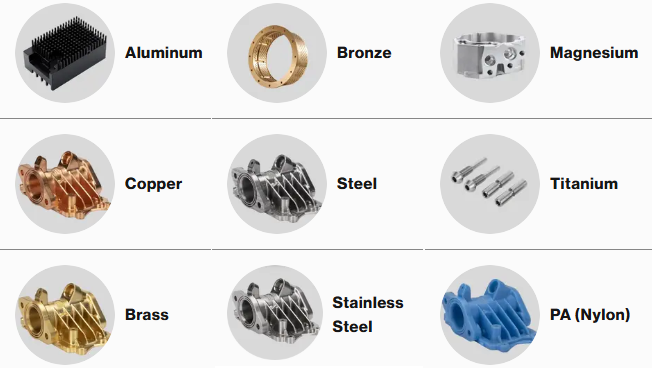
Material-Specific Considerations: Metals vs Plastics
Metals and plastics each bring characteristic behaviors that influence cost and lead time. Understanding these helps in selecting the most appropriate material family for a given application.
Metal Materials
Metals are typically chosen for strength, stiffness, and temperature resistance. Within metals, material choice substantially changes machining parameters.
Aluminum alloys:
- Generally high machinability, allowing fast cutting and short machining times.
- Support good surface finishes with appropriate tools.
- Relatively light, reducing handling effort for large parts.
Carbon and alloy steels:
- Moderate machinability, slower than aluminum but often acceptable for structural parts.
- Higher strength and wear resistance permit reduced part mass and thinner sections in many designs.
Stainless steels:
- Work hardening tendencies can complicate machining and accelerate tool wear.
- Typically require lower cutting speeds, increasing cycle time.
- Often chosen for corrosion resistance, which may justify higher machining cost.
Titanium and high-temperature alloys:
- Low thermal conductivity and high strength cause localized heat and heavy tool loading.
- Machining requires advanced strategies and often multiple light passes.
- Lead times may be extended due to limited machine and tooling availability.
Plastic Materials
Plastics are often chosen for weight reduction, chemical resistance, or electrical insulation. Their machining behavior differs significantly from metals.
Typical characteristics:
- Lower cutting forces and minimal tool wear, but higher risk of deformation from heat.
- Higher thermal expansion and creep, making tight tolerances more challenging.
- Potential for burr formation and stringy chips in ductile plastics.
Engineering plastics (e.g., POM/Delrin, Nylon, ABS) are generally easier to machine than fiber-filled or high-temperature plastics. High-performance plastics like PEEK often require careful control of cutting parameters and temperatures. Overall machining time may be low, but achieving precise tolerances and fine surface finish can require extra finishing steps.
Impact of Material on Surface Finish and Post-Processing
Required surface finish quality and intended post-processing steps are closely linked to material. Some materials naturally achieve the needed finish directly from machining, while others require additional operations that add time and cost.
Surface Finish from Machining Operations
Materials with homogeneous microstructures and good machinability, such as many aluminum alloys and free-machining steels, can achieve low roughness values with appropriate finishing passes. In contrast, materials that are gummy or prone to built-up edge may show torn surfaces or smearing, requiring more passes or specialized tools to achieve acceptable finish.
When surface finish requirements are demanding, especially on large surface areas or freeform geometries, finishing passes can significantly increase cycle time. Material choice that improves as-machined finish may allow reduction or elimination of separate polishing or grinding steps.
Compatibility with Secondary Treatments
Post-processing such as anodizing, plating, heat treatment, or painting depends heavily on material. Some considerations:
- Aluminum accepts anodizing well, adding corrosion resistance and aesthetic options, but requires proper alloy selection.
- Steels may need heat treatment after machining, which can cause dimensional changes and require final grind or skim cuts.
- Some plastics are sensitive to solvents in paints or coatings, limiting post-processing options.
When post-processing is required, its duration and sequence must be built into the project schedule. Materials that allow the desired properties without additional treatments often shorten total lead time.
Balancing Performance Requirements with Machining Efficiency
Choosing the optimal material is a balancing act between engineering performance and manufacturability. The most mechanically capable material is not always the best choice if it significantly increases cost and delivery time without proportional benefit.
Aligning Material Properties with Actual Requirements
Key design requirements to clarify before finalizing material include:
- Mechanical loads (static strength, fatigue, stiffness).
- Operating temperature range.
- Corrosion resistance and environmental exposure.
- Weight constraints.
- Regulatory or industry standards.
Once these are defined, multiple candidate materials can be evaluated not only for mechanical suitability but also for machinability, raw material availability, and total cost impact. Often, a more machinable alloy within the same family can meet the requirements at lower price and shorter lead time.
Design for Manufacturability (DFM) and Material Choice
Design for manufacturability is closely tied to material selection. Adjusting geometry to better match the machinability characteristics of a material can reduce setups, minimize tool changes, and shorten machining cycles. Examples include:
- Choosing wall thicknesses compatible with the stiffness of the selected material.
- Avoiding unnecessarily deep pockets when using low-machinability alloys.
- Specifying tolerances that are achievable without additional grinding or secondary operations.
When designers collaborate with machinists early and consider material effects on process steps, many cost and scheduling issues can be resolved before any chips are made.
Comparative Overview of Material Effects on CNC Projects
The following table summarizes typical influences of major material groups on cost and lead time to support initial material screening for CNC-machined parts.
| Material Group | Relative Material Cost | Relative Machining Time | Tooling Demand | Typical Lead Time Impact |
|---|---|---|---|---|
| Common aluminum alloys (e.g., 6061) | Low–medium | Low (fast cutting) | Low–medium | Short; widely available, easy to schedule |
| Free-machining steels and brasses | Low–medium | Low–medium | Low–medium | Short–moderate; good for volume production |
| Carbon and alloy steels | Medium | Medium | Medium | Moderate; common stock but slower machining |
| Stainless steels | Medium–high | Medium–high | High | Moderate–long; slower cutting, more tool wear |
| Titanium and high-temperature alloys | High | High (slow cutting) | High | Long; specialized machines and tooling |
| Standard engineering plastics | Low–medium | Low–medium | Low | Short–moderate; attention needed for tolerances |
| High-performance plastics (e.g., PEEK) | High | Medium | Medium | Moderate–long; material procurement can dominate |
This overview cannot replace detailed project-level analysis, but it highlights how a change in material group alone often shifts the cost and time profile of a CNC machining job.
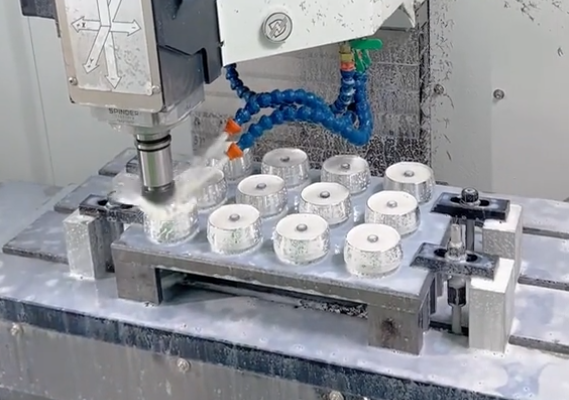
Common Issues Related to Material Selection
Material decisions often create practical difficulties in CNC projects when not fully aligned with machining realities. Typical issues include:
- Specifying difficult-to-machine alloys for non-critical parts, inflating cost and delaying schedules without clear performance benefits.
- Choosing materials with limited availability or long procurement times that exceed machining time itself.
- Requiring extremely tight tolerances in materials prone to warping or thermal expansion, leading to rework and extended iteration cycles.
- Underestimating the impact of tool wear and machine capability when machining very hard or abrasive materials, resulting in unplanned downtime.
Addressing these points early by considering both engineering and manufacturing constraints usually leads to more predictable budgets and delivery times.
FAQ: Material Choice, CNC Cost, and Lead Time
How much can material choice change CNC machining cost?
Material choice can easily change total CNC machining cost by a factor of two or more for the same geometry. The main drivers are machinability (cutting speeds and tool life), raw material price, and required post-processing. For example, a part machined from a common aluminum alloy is typically much less expensive than the same part made from titanium, due to lower raw material cost, faster cutting, and reduced tooling demands.
Why are aluminum parts usually faster and cheaper to machine than steel?
Aluminum has high machinability, allowing higher cutting speeds and feed rates that shorten machining time. It is also relatively soft, reducing tool wear and enabling less expensive tooling. Common aluminum alloys are widely available in standard stock sizes, which reduces material lead time and scrap. These factors combined make aluminum parts generally faster and less costly to machine than comparable steel parts, assuming similar design and tolerance requirements.
When is it worth using a harder-to-machine material?
Using a harder-to-machine material is justified when performance requirements cannot be met by easier materials. Examples include high-temperature operation, extreme corrosion resistance, very high strength or stiffness in compact designs, or strict regulatory standards. In these cases, the higher machining cost and longer lead time are offset by the functional advantages and safety or compliance needs of the application.
How does material availability affect CNC lead time?
If a material is commonly stocked by suppliers or machine shops, raw material can often be obtained quickly, and lead time is dominated by programming and machining. For less common grades, unusual sizes, or specialty alloys, procurement can take significantly longer than machining itself. This extended sourcing time directly adds to project lead time, even when actual cutting operations are relatively short.
Can changing material reduce both cost and lead time without redesigning the part?
In many cases, yes. If the original material specification is conservative relative to actual loads or environment, switching to a more machinable but still suitable material can reduce cycle time, tool wear, and raw material cost. This often shortens lead time and lowers price without altering geometry. However, any material change should be evaluated for its effect on mechanical properties, regulatory requirements, and long-term performance.